AI Interview Tools and Predictive Validity Evidence
Most AI hiring tools lack the validity evidence that actually predicts job performance.

AI interview tools have become a mainstream part of hiring almost overnight. Fifty-one percent of organizations now use AI specifically for recruiting, according to SHRM's Talent Trends survey of 2,040 HR professionals, up from just 26% in 2024. Ninety-nine percent of Fortune 500 firms have some form of AI in their hiring stack, and 87% of companies use AI somewhere in the process. But growth in adoption says nothing about whether the tools actually work. Most buyers pick a platform based on speed, interface polish, and vendor claims, without asking the one question that actually decides whether a hire will succeed: does this tool predict who performs well on the job?
That question has an answer. It's just buried in decades of personnel psychology research that most vendors don't cite and most buyers don't ask for. This piece lays out how to read that evidence, so the distinction between a tool that automates speed and one that improves decisions stops being a guess.
What predictive validity means
Predictive validity is a correlation coefficient, written as r, between a score from an assessment and how that person actually performs on the job later. It's the standard unit of measurement across personnel psychology, and it's the number every hiring tool should be judged against.
The scale runs like this. An r of 0 means the tool tells you nothing, it might as well be a coin flip. An r of 0.30 counts as a solid, business-relevant predictor, according to Cogn IQ, as cited by Tesseract Academy. An r of 0.50 or higher counts as strong, and very few individual selection methods ever get there on their own.
If a vendor can't state accuracy as a validity coefficient, benchmarked against an established selection method, they haven't given you a measurable claim. They've given you marketing.
Criterion-related validity (does the score actually correlate with performance outcomes down the line?) should be separated out from weaker cousins like face validity or content validity, which just ask whether a test looks reasonable or covers the right topics on paper. Vendors sometimes swap one for the other without saying so.
A couple of due-diligence habits matter here. Independent, peer-reviewed research carries far more weight than an internal white paper, and Tesseract Academy (2026) flags exactly this: ask whether a study was published independently, or funded and kept in-house by the vendor selling the tool. And scoring should be traceable. Every number a candidate receives ought to point back to a specific moment in the transcript, not arrive as a black box. That matters for legal defense, and it matters just as much for whether a hiring manager actually trusts the shortlist in front of them.
Where traditional interview methods sit in the validity hierarchy
Most hiring leaders assume their interview process filters well. For a lot of that process, the research says otherwise.
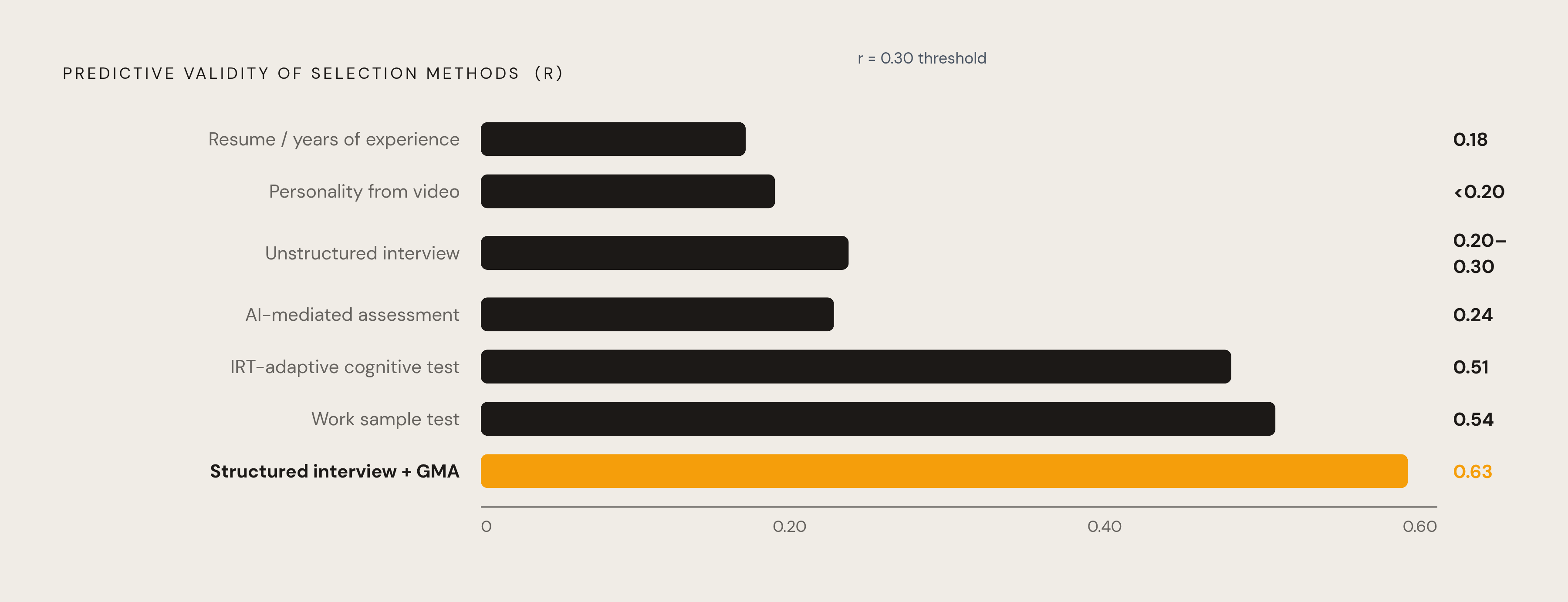
Unstructured interviews, still the default at most companies, sit at a predictive validity of just 0.2 to 0.3, barely above guessing, according to TheHireHub.ai (2026), citing established personnel research. That's barely above guessing. Sackett et al.'s 2022 revisions push the number even lower, per Tesseract Academy.
Structured interviews change the picture. Standardized questions, behavioral anchors, systematic scoring, these outperform unstructured interviews by 24% or more in predicting actual job performance, per TheHireHub.ai. Combine a structured interview with a general mental ability measure, and Schmidt and Hunter's research (cited widely across the field) puts predictive validity at.63, among the highest documented for any selection method.
Compare that to what a lot of hiring managers lean on instead. Years of experience alone predicts at r =.18, with returns flattening out after about five years. Education alone scores even lower, per Tesseract Academy.
So the real question for AI interview tools isn't whether they beat the theoretical best process research can build. It's whether they beat what teams are actually running today, and for most teams, that bar sits low enough to clear.
What the AI-specific validity evidence shows, and where it is still thin
AI-run structured interviews land closer to the structured category than the unstructured one, because they enforce consistency: the same questions, the same scoring rubric, for every candidate, according to Tesseract Academy.
A 2024 study on AI-mediated assessments found a criterion-related validity of.24 for predicting job performance. That confirms AI scoring can predict performance reliably at scale, even if it trails the top human-run structured interviews.
Field data backs this up in a different way. A 2025 field experiment on arxiv, using randomized application processes for a junior software engineer role, found 54% of candidates from the AI-assisted pipeline passed the final human interview, versus 34% from the traditional process, a 20 point gap attributable to the AI-assisted screening. That's a 20 point gap, attributable to the AI-assisted screening.
The strongest predictor in the mix isn't new, and it isn't really "AI" in the generative sense. IRT-adaptive cognitive testing scores r =.51, the highest single predictor of job performance across roles, backed by decades of peer-reviewed research, according to cogn-iq.org (2026). AI here enhances an existing, well-proven psychometric method rather than replacing it. Work sample tests score even higher, at r = 0.54, with 40 to 60% lower adverse impact than cognitive tests alone, per CIPD's selection methods review, cited in Klearskill.
Then there's the part of the evidence base that should give any buyer pause.
- Full personality inference from interview video scores under 0.20, worse than a decent unstructured interview, and legal exposure across the EU and several US states has only gotten sharper, per Klearskill.
- Voice tone and vocal prosody analysis gets flagged as invalid outright. Accent, dialect, language proficiency, and plain nervousness all confound the signal, which undermines the construct itself and raises fairness problems on top, according to cogn-iq.org.
- Resume keyword screening run through NLP just automates a weak predictor (r of about.18). Layering natural language processing on top doesn't add validity if the underlying signal wasn't predictive to begin with, per cogn-iq.org.
- Fully automated scoring of behavioral signals, with no human reviewing the output, carries legal and accuracy risk that rarely earns its keep, according to Klearskill.
The pattern across all four: automation applied to a weak signal just produces a faster, more scalable weak signal. That's the trap: automation applied to a weak signal just produces a faster, more scalable weak signal. Speed isn't the same thing as accuracy, and a tool can excel at one while failing at the other.
The five working categories of AI interview tools and what each one delivers
Klearskill (2026) breaks the market into five working categories. Each should be walked through on its own terms, from lowest decision impact to highest.
Scheduling and coordination assistants. These parse availability across panels, candidates, and time zones, and handle constraints that would otherwise eat up a coordinator's whole day. Gartner, cited in Klearskill (2026), found scheduling automation cuts interview no-show rates by 27%. The stakes here are low: a scheduling error is annoying, not disqualifying, and mature tools keep a human fallback in the loop. Klearskill (2026) names GoodTime, Modern Hire's coordination layer, and Calendly's recruitment tier as examples, running roughly $3 to $8 per scheduled interview. This category has become table stakes for any team juggling more than a few open roles at once.
Async video interview platforms with AI scoring. Candidates record answers to preset questions, and an AI layer transcribes, summarizes, and in some products, scores those answers against a rubric. Research cited by McKinsey, referenced in Klearskill (2026), found async screening cuts total interviewer hours per hire by 41% without hurting offer-to-hire conversion. But the defensibility line matters: Illinois regulates emotion analysis in employment settings, requiring notice and consent, and the EU AI Act broadly restricts it in the workplace. The deployments that hold up in 2026 use AI for transcription and summarization, surfacing a candidate's own words, not for scoring behavior. Klearskill (2026) names Spark Hire and VidCruiter here, at roughly $250 to $1,500 a month for small and mid-size teams. The tradeoff to watch: the scoring layer is only as sound as what it's scoring, so run the validity hierarchy above against any automated scoring feature before switching it on.
Live interview copilots. These join the call as a bot, transcribe in real time, suggest follow-up questions, and produce a summary mapped to the scorecard. SHRM, cited in Klearskill (2026), found interviewers using live transcription recall 34% more of a candidate's actual answers correctly when scoring afterward, compared to those working from handwritten notes. Consent rules vary by jurisdiction, and candidates can find the setup unsettling if it isn't introduced with care. Klearskill (2026) names Pillar and BrightHire in this space, alongside others, with pricing that varies by vendor and deal size.
Structured scoring and calibration tools. This is where interview intelligence sits closest to the actual decision. These tools enforce scorecard discipline, hide peer ratings until every interviewer submits their own, and run calibration analytics to catch drift in rating standards over time. One company, cited by talentfrequency.com, found its "culture fit" assessment carried zero predictive validity, while its problem-solving questions correlated strongly with performance, so it dropped culture fit scoring entirely. Tools in this category also surface interviewer-level validity data, and interviewer-level analytics that scheduling or transcription tools simply can't produce. Klearskill (2026) names this as a distinct category without attaching specific products to it.
End-to-end interview intelligence platforms. These combine transcription, evidence-based scoring, calibration analytics, and in the most advanced cases, agentic AI that makes recommendations and flags mismatches on its own. Klearskill reports leading integrated platforms deliver time-to-hire improvements for teams that adopt them fully, plus analytics most single-purpose tools can't touch. Klearskill also reports its own AI screening platform cuts screening time by 92%, though no outside research (from McKinsey or otherwise) has been found supporting figures at that scale.
One sub-category deserves a flag here: generative AI "interview avatars" that run an entire interview with no human present. Candidate experience scores on these run poor, and legal defensibility is thin given the EU AI Act's scrutiny of automated decision-making in employment, per Klearskill. The direction the category is actually heading looks different: full-cycle systems that combine sourcing, interviews, and technical assessment into one evidence-attached shortlist, avoiding the handoff failures that creep in when each piece lives in a separate tool.
Why calibration, not the tool itself, determines whether AI interviews improve decisions
Even a genuinely validated tool produces noise if it's scoring against the wrong criteria. The company that found zero predictive validity in its culture fit questions, while problem-solving questions correlated with performance, makes the point cleanly: the tool wasn't broken, the target was.
Without calibration, hiring turns into a subjective lottery. One interviewer rates a candidate exceptional, another rates the same person mediocre, and neither has any external check on which read is closer to true. AI-powered interview intelligence earns its keep by surfacing evidence-based scores at the moment of evaluation, tied to what a candidate actually said rather than a gut impression formed twenty minutes in. That structured layer is where the real validity gains occur, per TheHireHub.ai (2026).
SeekOut's 2026 recruiting metrics guide points to a few numbers to track directly:
Interview-to-offer ratio. A healthy benchmark is around 3:1. Anything above 4:1 suggests too many borderline candidates are making it to final rounds, a sign that screening criteria have drifted out of calibration. Quality-of-hire. Best measured as a weighted blend of 90-day manager ratings, early performance signals, and 12-month retention, not any single one of those alone. First-year attrition. Landing between 12% and 15% is typical. Climbing past 15% points to a mismatch somewhere: in screening, in expectations set during the process, or in onboarding once the person starts.
Calibration isn't a setup task to finish once and forget. It should sharpen with every round of interview feedback, and any change to a scoring standard ought to be visible and reasoned, approved by a person, not adjusted quietly by an algorithm behind the scenes. Teams running fully calibrated, AI-scored interviews tend to report quality-of-hire improvements that take months to surface, along with faster time-to-fill as structured scoring cuts down the back-and-forth that usually stalls a hiring committee.
The legal and fairness terrain buyers cannot afford to treat as secondary
Notice which categories carry the weakest validity evidence: personality inference from video, vocal prosody, unreviewed automated scoring. Now notice that those are the same categories drawing the most regulatory scrutiny. That's not a coincidence. Both problems trace back to the same root: a scoring signal that doesn't actually measure anything job-relevant.
The EU AI Act classifies automated scoring in employment decisions as high-risk. Tools that can't produce an audit trail, explainable and tied to specific evidence, face real exposure under that framework. In the US, Illinois' AI Video Interview Act and similar state laws restrict or require disclosure when AI analyzes facial expressions, vocal characteristics, or other behavioral signals during hiring, per Klearskill.
Voice tone and vocal prosody analysis is worth returning to here, because it shows how tightly validity and fairness are bound together. Accent, dialect, language proficiency, and interview anxiety all distort the signal these tools claim to read, according to cogn-iq.org. That's a validity failure. It's also a fairness failure, and treating the two as separate concerns misses the point: a tool that can't measure the right thing accurately is, almost by definition, going to measure it unevenly across different groups of candidates. Buyers who treat legal review as a final checkbox, after the tool's already been selected on speed and cost, have the sequence backwards.
Sources
- Interview Intelligence: The AI-Powered Hiring Edge
- AI Interview Tools in 2026: Which Actually Improve Hiring Decisions | Klearskill
- AI in Hiring Assessments
- How Accurate Are AI Interviews at Predicting Job Performance? - Tesseract Academy
- Better Together: Quantifying the Benefits of AI-Assisted Recruitment
- Pre-Employment Assessment Tools: 2026 Buyer's Guide | Klearskill
- seekout.com
- talentfrequency.com