What AI Resume Screening Actually Filters Out
AI screening doesn't spot talent mismatch—it just rewards the resume format past hires had.
AI resume screening doesn't just thin out a pile of applications. It rewards one specific kind of candidate and, in the same motion, erases another kind just as reliably. The credential pattern that gets through is predictable. So is the one that doesn't. That second pattern is the one hiring teams need to understand, because volume already forced automation into the process and nobody's going back.
Nearly every Fortune 500 company runs an applicant tracking system now, and the share of organizations using AI for HR tasks jumped from 26% to 43% in a single year. Why the jump? Volume. A typical corporate posting pulls in 242 to 257 applications. Some remote tech roles hit 1,200 within days. Against that flood, a hiring manager spends about seven seconds per resume, on average. Something has to triage the pile before a person opens it.
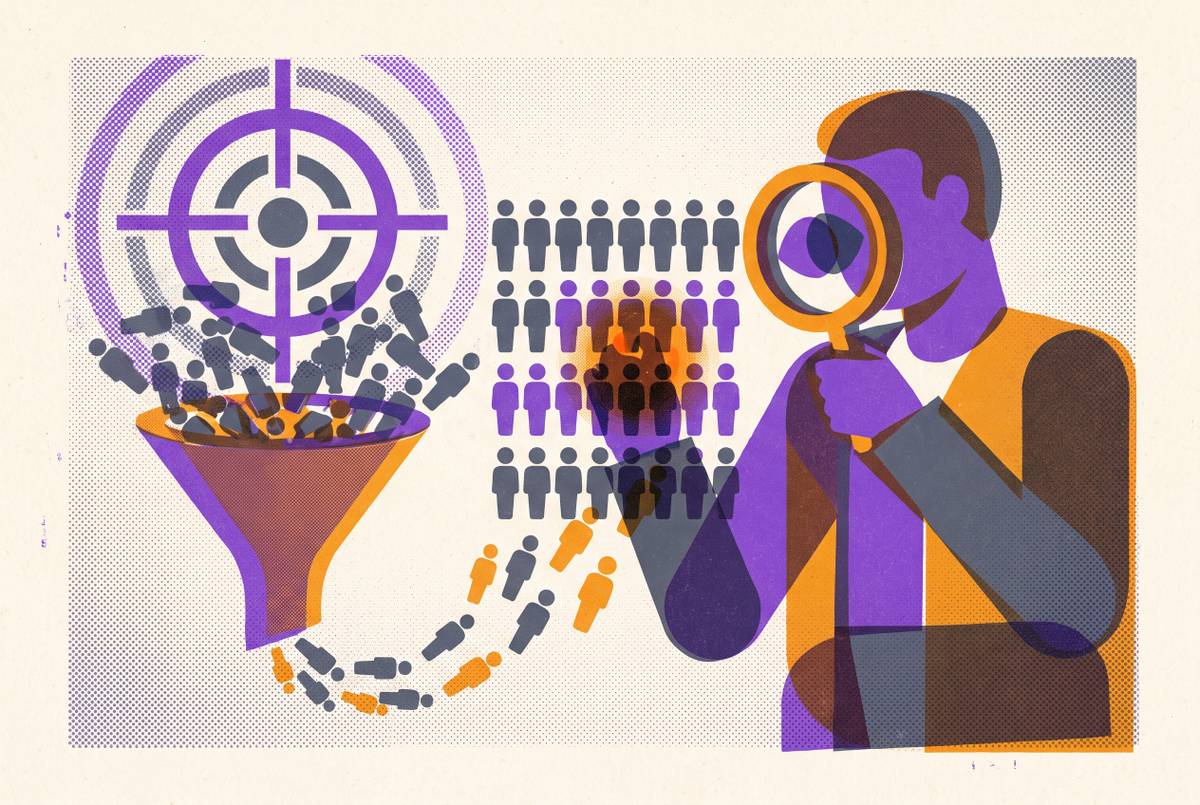
Mechanically, the process breaks into three steps. The system parses a resume into fields: skills, job titles, tenure, education. It compares those fields against the job description using keyword matching, semantic similarity, or a model trained on past hires. Then it scores the resume, and anyone below the threshold never reaches a human being.
That's the filter in question. These are yes-or-no decisions made before anyone reads the work behind the words. So the real question is who lands on the wrong side of AI screening, and why that side keeps looking the same. It's who lands on the wrong side of it, and why that side keeps looking the same.
The credential patterns AI screening is optimizing for
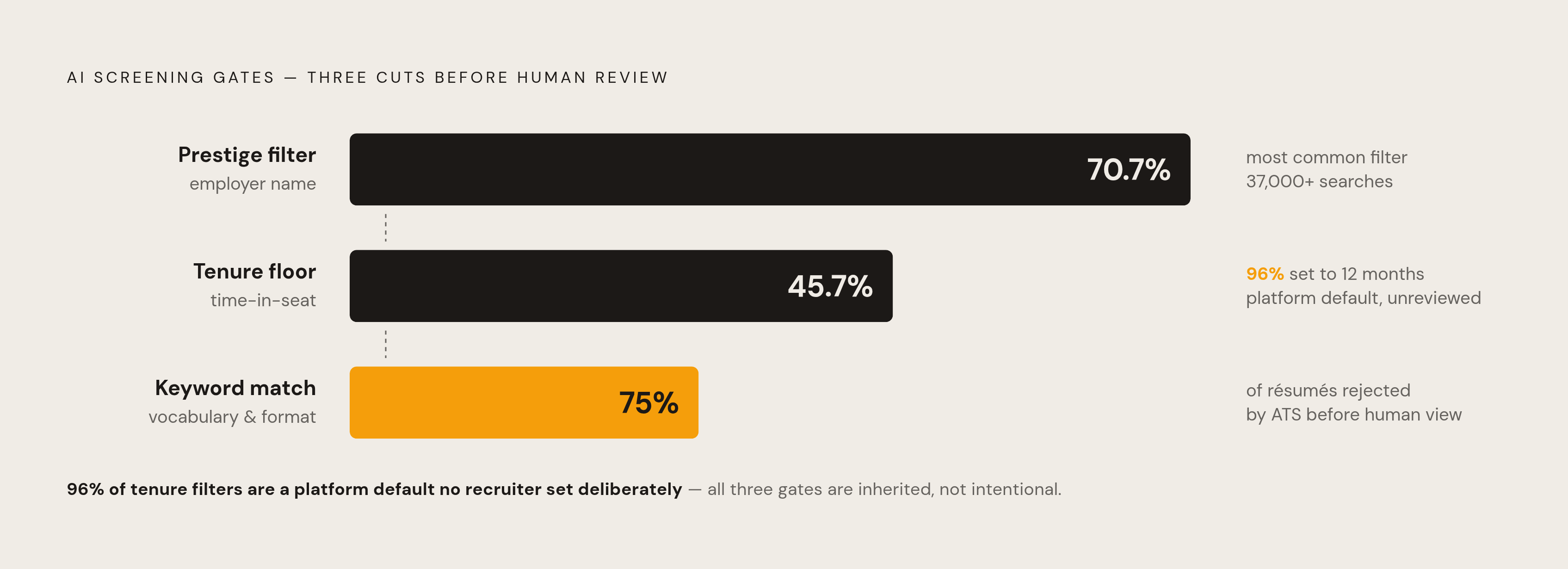
Start with what sourcing tools filter on before a model ever scores anything. An audit of more than 37,000 recruiter sourcing searches found that 70.7% applied an employer-prestige filter, the single most common filter in the dataset, and it runs before AI enters the picture at all.
Years-of-experience floors are present in 45.7% of searches, and 96% of those tenure filters, within the audited searches, are set at exactly 12 months. No recruiter sat down and decided a year was the right cutoff for a given role. That's the platform default, and almost nobody touches it.
Both filters encode a shortcut, and it's the wrong one. Prestige filtering assumes quality transfers from an employer's name, treating where someone worked as a stand-in for what they can actually do. The tenure floor assumes time-in-seat signals depth, rather than what got shipped during that time. Both look backward, rewarding pattern-matching against who got hired before instead of predicting who'll succeed next.
Then there's the job description itself, which acts as the training signal for the whole match. Most systems score resumes against a JD written in standard industry vocabulary, so a candidate doing the exact same work but describing it in a different industry's language, a different country's conventions, or under a non-standard title becomes semantically invisible. The system correctly matches the words it is given. It just never sees the match.
Formatting adds one more cut. Up to 75% of resumes get rejected by ATS platforms over formatting errors or missing keywords. The filter is catching presentation, not capability, and that distinction gets lost by the time a rejection email goes out.
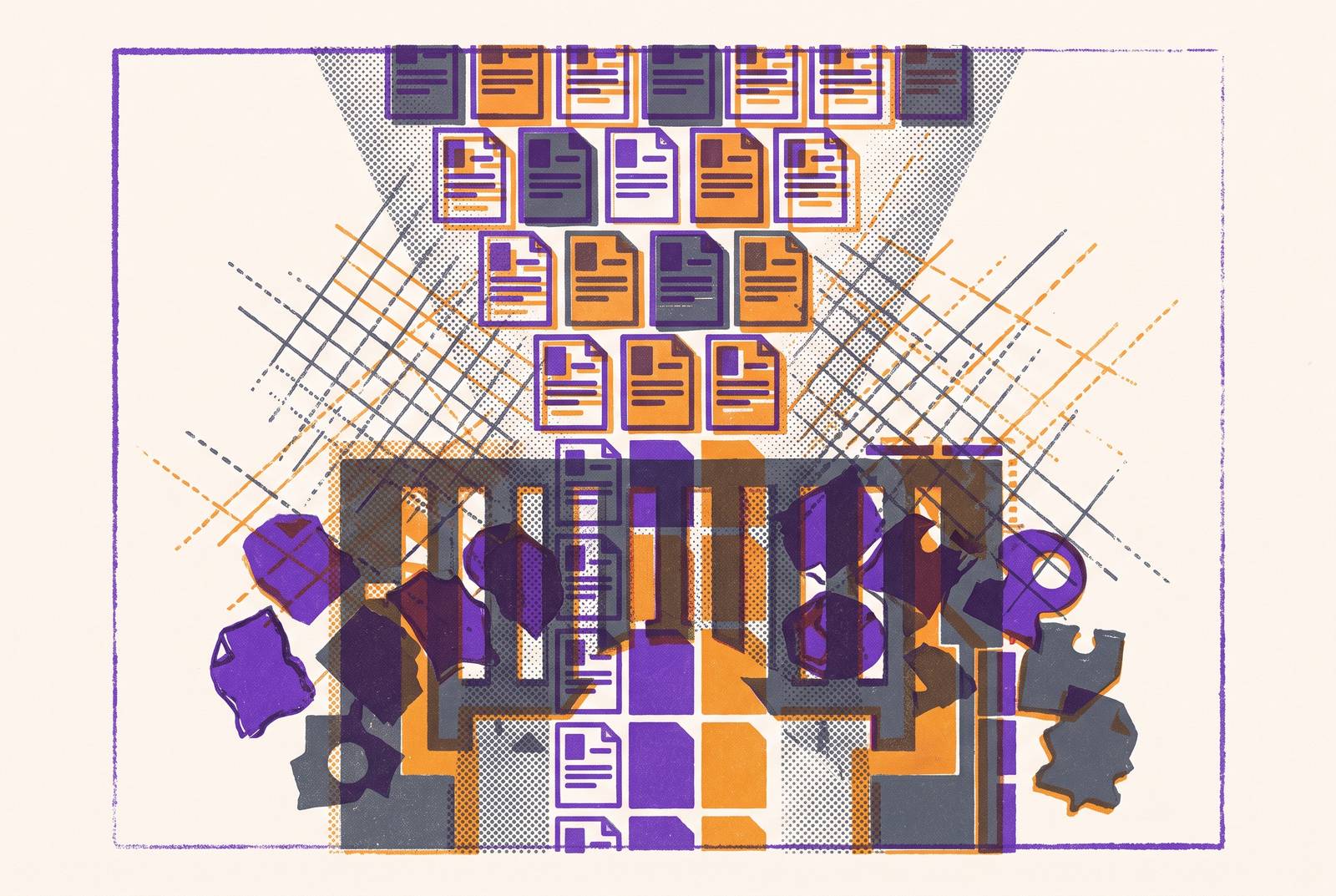
Run all three filters in sequence, prestige, then tenure, then keyword match, and each one is defensible on its own. But the pool narrows three separate times, each cut removing a slightly different kind of qualified person. What's left at the end is a narrow, specific profile, and it's not the one the phrase "best available talent" would lead anyone to expect.
The specific profiles that fall through every time
Picture the former teacher moving into learning and development, or the self-taught engineer whose title history doesn't match the standard ladder. Their skills get described in language that isn't the industry default, so semantic matching scores them low even when the underlying capability matches a candidate who happened to use the "right" words.
The pattern is most visible at the edges. Accuracy drops for senior roles, niche specialisms, international candidates, and anyone with a non-linear career path. In fast-moving fields, AI being the clearest current example, some of the strongest professionals have unconventional paths, where hands-on work predicts success better than any credential lineage does. The tools built to reward lineage miss exactly these people.
Most of this comes down to a mismatch in words. Research on the topic shows that vocabulary, titles, or phrasing that don't match what the model expects cause false negatives, even when the substance is identical. Same skill, different words, invisible to the parser.
International and non-native English candidates carry a heavier version of this risk. Name formats outside a common regional convention can trip the parser. Date formats that don't match what the system expects break tenure calculations outright. And AI text detectors, increasingly used to flag "machine-generated" resumes, tend to flag tight, keyword-driven bullet points as suspicious, regardless of who actually wrote them. Non-native English writers absorb that false-positive risk on top of everything else already stacked against them.
Then there's the builder without a brand-name employer. Real shipped work, strong output, but an employer name the prestige filter doesn't recognize. That resume gets cut before a human reads a single bullet.
And the employment-gap candidate: six months or more away from work, for caregiving, illness, or a startup that didn't pan out, treated by default as a red flag instead of a footnote.
Capability is not what these people lack. What they're missing is the specific credential shape the system happens to reward.
Why the system's errors run in one direction
In a 2024 study of language-model resume rankers (Wilson and Caliskan, AIES), white-associated names were preferred 85.1% of the time, Black-associated names just 8.6%, across roughly 40,000 paired comparisons. In head-to-head tests pitting a Black man against a white man, the Black candidate was chosen zero times out of three model tests. Zero.
A fluke of one study's design? A 2025 follow-up ran more than 3 million comparisons and found the same pattern, calling it the "Illusion of Neutrality": models look unbiased because they're matching on keywords, but keyword matching is itself a proxy for credential familiarity, and credential familiarity is already skewed toward whoever got hired in the past. A separate Brookings and Stanford-MIT study found racial bias in 93.7% of the AI screeners tested, a figure that covers close to the entire industry. That's close to the entire industry. That's close to the entire industry.
Why does the mechanism land there every time? Predictive ranking trained on historical hires learns whoever got hired before. If past hiring skewed toward a narrow demographic profile, the model learns to prefer that profile going forward, quietly, without anyone instructing it to. The prestige filter and the 12-month tenure default get set uniformly at the platform level, so the outcomes stop being uniform the moment you look at who they actually affect.
The EEOC's adverse-impact framework, under the Uniform Guidelines codified at 29 CFR Part 1607, treats facially neutral defaults as legally actionable when the outcomes disadvantage protected groups. That's not hypothetical, and it's not a coin flip either. The system doesn't fail at random. It fails in one direction, repeatedly penalizing the same kinds of candidates, and that pattern only becomes visible once someone actually audits the output.
The exposure attached to that failure isn't abstract anymore. The EEOC logged 88,531 discrimination charges in fiscal year 2024, a 9.2% jump from the year before. Texas's TRAIGA now applies to AI-assisted screening, and the EU AI Act's Annex III carries fines that can reach a hefty share of global revenue. AI-assisted screening sits squarely inside all of it.
What hiring teams don't see because false negatives are invisible
An asymmetry runs through how these errors get caught, or don't. A false positive, a weak candidate who slips past the screen, eventually gets caught in an interview. Someone talks to them, notices the gap, moves on. A false negative never gets that chance. The strong candidate who got filtered out is never interviewed, never seen, and never corrected for.
No feedback loop exists to catch it either. The system has no way to learn it missed someone, because rejected candidates don't re-enter the pipeline with an outcome attached. The error just sits there, compounding quietly, invisible by design.
One SHRM survey on AI in HR found 19% of organizations using hiring automation reported their tools had screened out qualified applicants. That's the share who happened to notice. That's the share who happened to notice.
AI-generated resume detection stacks another layer on top of this. In 2025, 62% of employers reported rejecting AI-generated resumes that lacked personalization, a reasonable instinct on its face. But the tight, keyword-driven bullet format that any well-crafted resume uses looks machine-generated to a detector. People who wrote their resumes entirely by hand, some going back to 2015, routinely score high on AI-probability detectors. Rejecting on that score alone throws out real, qualified people based on a proxy that measures formatting, not authorship.
What does a bad filter actually cost? Cost-per-hire benchmarks, whatever the figure, only describe hires that happened. The strong candidate who never got surfaced does not appear in any spreadsheet. That cost is untracked, unrecovered, and invisible to the people who'd most want to know about it.
That gap bites harder in a tight market. Global demand for AI talent continues to outpace available supply. When qualified people are already scarce, a screening funnel that quietly eliminates non-obvious strong fits is actively working against the goal it's supposed to serve. It's actively working against the goal it's supposed to serve.
Where AI screening performs well and where calibration changes the outcome
None of this means the tools are broken across the board. Accuracy runs highest for high-volume, repetitive roles with precise job descriptions and candidates who use standard industry vocabulary. In that narrow band, the system performs close to as advertised.
The gap opens up everywhere else, and it comes down to calibration. Most screeners are calibrated to whoever got hired before, at whatever company trained the underlying model. They're calibrated to whoever got hired before, at whatever company trained the underlying model. Small distinction, big consequence: the tool isn't measuring against your bar. It's measuring against someone else's bar, set in the past, for a different team entirely.
Real calibration means dropping the standardized job description and building team-specific performance benchmarks instead. LinkedIn's Future of Recruiting Report found quality-of-hire, in practice, gets measured through a mix of signals: job performance ratings (used by 66% of talent acquisition professionals) and new-hire retention (60%). None of that lives on a resume. All of it has to come from a specific team's track record, not get inherited wholesale from a generic model trained somewhere else.
OpenEvidence offers one example of this in practice: its recruiter partners directly with founders to define what "exceptional" means for that specific team, rather than importing a definition built for someone else's org chart.
That same LinkedIn report found 61% of talent acquisition professionals believe AI can improve how quality of hire gets measured. That belief comes with a condition attached: it depends entirely on how the tool gets configured, not on some property baked into the tool itself. Treated as an ongoing process, updated as interview outcomes reveal what actually predicts success at a given team, a system's definition of a strong candidate can shift over time instead of staying frozen at whatever pattern it learned on day one.
What a less filtered pipeline surfaces
Loosen the filters, and a different set of profiles appears. Technical specialists from non-traditional backgrounds never appear through conventional sourcing at anything close to their real numbers. Military veterans and career-changers get filtered out at the very first screen, under credential defaults that were never built with them in mind. Candidates whose real work lives in places AI sourcing tools don't typically index at all: GitHub repositories, patent filings, academic papers, open-source contributions.
What replaces the credential as a signal? Evidence. What someone actually built, shipped, or solved, not where they built it or what the employer's name is worth on a resume. That shift, toward skills-based assessment at the screening stage instead of credential-based filtering, changes what gets evaluated: capability, not pedigree.
The data backs this up directly. A Stanford field study found candidates who went through AI-led interviews succeeded in the human interviews that followed at a 53.12% rate, notably higher than candidates who came through a traditional resume screen (per the World Economic Forum). A separate SSRN field study, covering roughly 70,000 interviews, found AI-led interviews produced 12% more job offers and 17% higher 30-day retention. The implication is hard to dodge: whatever the resume screen filtered out included people who went on to perform better once someone actually evaluated them.
The diversity effect visible here is not a separate initiative bolted on afterward. It's a byproduct of removing the prestige filter and the vocabulary mismatch that quietly excluded certain candidates in the first place. Widen the pool by evidence instead of pattern, and the pipeline gets more diverse structurally, not because anyone set out to build one that way.
Human judgment still has real work to do here, just not the work it's currently doing. It belongs at the decision point, weighing context and making the final call, not running an elimination process before any real evaluation has happened.
Practical checks hiring teams can run on their own screening funnel
Start with the filters, not the model. Pull up which ones are active and what the defaults are set to. If 96% of minimum-tenure filters industry-wide are set at exactly 12 months, there's a decent chance that's a platform default nobody on the team ever actually reviewed. Check whether a prestige filter is running too, and ask honestly whether it's doing intentional work for this specific role, or just inherited work from a template someone copied years ago.
Reserve auto-disposition for clear, job-related knockouts: certification requirements, legal work authorization, things with a genuine bright line. Not credential proxies standing in for evaluation that never actually happened.
Strip names, photos, graduation years, and addresses before resumes reach human reviewers. That single step removes a lot of the surface area where name-based and address-based bias creeps into the process before anyone's even aware of it.
Don't lean on AI text detectors to flag resumes as inauthentic. They're error-prone, and the errors land hardest on non-native English writers. Rejecting a candidate on a detector score alone risks real legal exposure, and it throws out qualified people based on a signal that measures phrasing, not truth.
Run a false-negative sample every so often. Pull a batch of rejected resumes, hand them to a sharp human reviewer, and check them against what the role actually requires. What that exercise reveals tends to be the clearest evidence of what the funnel has been missing all along.