AI Sourcing Accuracy Against Human Recruiters
AI beats human recruiters at high-volume screening, but humans still own assessing individual fit.
AI sourcing and human recruiters get compared like there's one accuracy score that settles the argument. There isn't. What matters is narrower: which task are you measuring, and does the tool in front of you actually fit that task? Get that wrong, and every number in this debate turns into decoration.
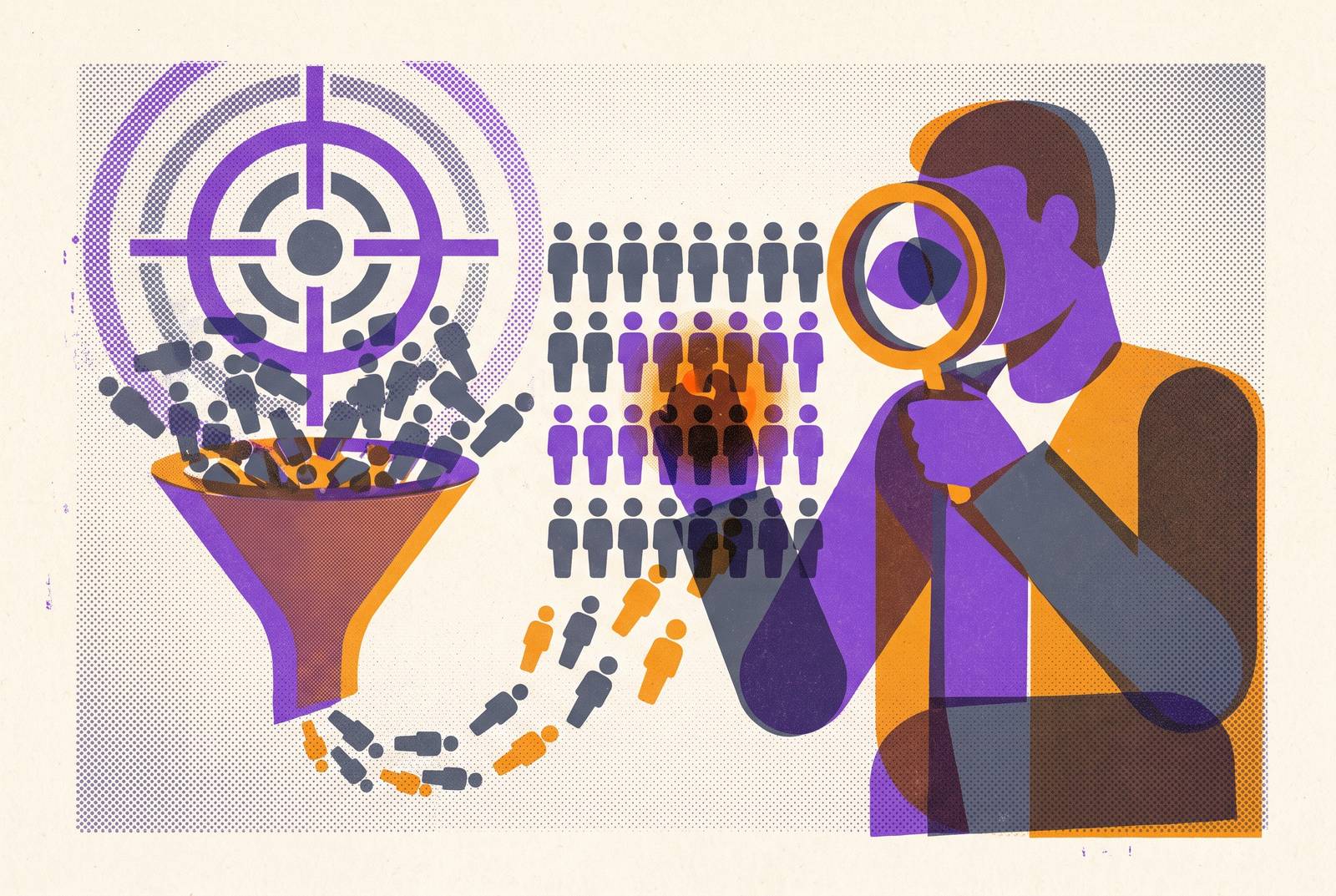
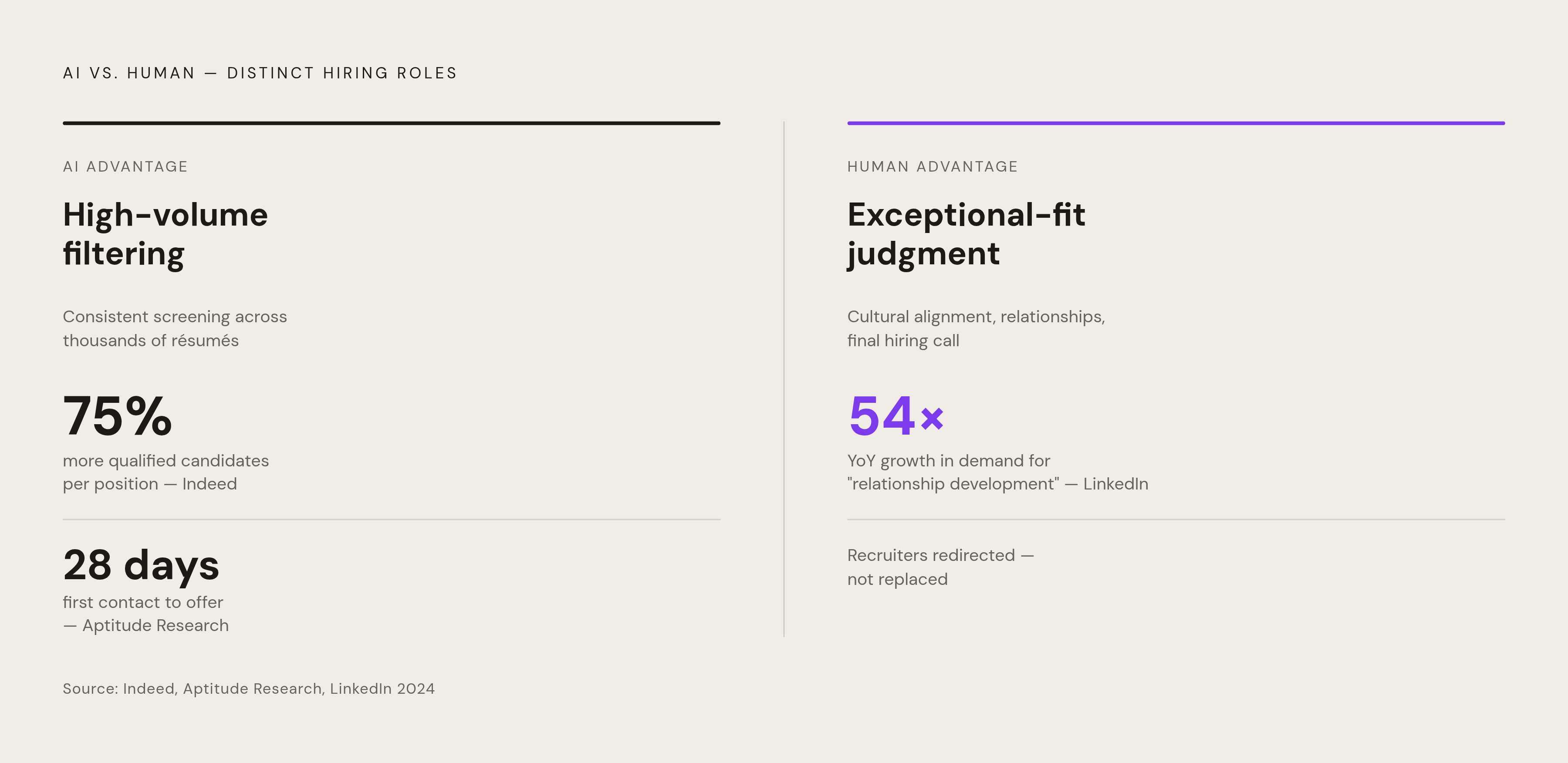
Hiring splits into two very different jobs. One is high-volume filtering, where consistency across thousands of resumes keeps the same standard applied to every candidate, rather than letting one reviewer's mood or fatigue skew the outcome. The other is figuring out whether one specific person is exceptional for one specific team, and that's closer to taste than pattern-matching. AI wins the first job outright. Humans still own the second, and should keep owning it. Most "AI vs. recruiter" debates fall apart because they blend these two tasks into a single number, then act surprised when the number doesn't mean much.
SHRM found AI use across HR tasks hit 43% in 2026, up from 26% two years earlier, with recruiting leading every other HR function at 27% of organizations already using it. The tools are already inside the process, whatever division of labor a company has or hasn't worked out. What follows won't crown a winner between AI and recruiters, since that's the wrong contest to run. It'll show which accuracy claims hold up once you specify what's actually being measured, and which ones quietly fall apart.
Where AI sourcing genuinely outperforms human recruiters
Start with a plain fact about attention. Eye-tracking research published in the Journal of Personnel Psychology found recruiters spend an average of 7 seconds per resume, and screening accuracy drops significantly after reviewing 30 or more resumes in one sitting. That's not a knock on any individual recruiter. It's what happens to anyone doing repetitive visual scanning for hours on end. AI doesn't get tired, and it applies the same criteria to candidate 1 and candidate 500.
That consistency is the real edge here, not superior insight. And it appears most where multiple human reviewers would otherwise disagree with each other, let alone with themselves on a different day.
Indeed reports that companies using AI sourcing tools find 75% more qualified candidates per position than traditional methods. Some of that gap comes down to reach: manual sourcing barely touches truly passive candidates, and at any given moment, most of the workforce sits in that category, not actively applying anywhere. AI can score a large pool of passive profiles in the time it would take a person to open a few dozen of them.
Semantic search adds another layer. Instead of matching keywords, it matches meaning, and available estimates suggest meaningfully more relevant profiles than Boolean search, with fewer false positives along the way. That directional advantage appears consistently across industry data, though no single figure has been fully verified. Semantic beating keyword matching is visible consistently across industry data regardless of the exact number attached to it.
There's a quieter win buried in here too: silver medalist recapture. Any company with a few years of ATS history has candidates sitting in it who were genuinely qualified but lost out on timing rather than fit. AI can surface those people again, and response rates on that kind of re-engagement tend to beat cold outreach by a wide margin.
Speed compounds all of this. Industry data consistently shows top talent moves quickly once available, often within a matter of days. Aptitude Research found roles using AI-assisted sourcing average 28 days from first contact to offer acceptance, a meaningful compression compared to traditional timelines. That kind of speed matters directly when strong candidates are already fielding other offers.
Where the accuracy claims get overstated
The commonly cited "92% AI resume screening accuracy" figure sounds impressive until someone asks the obvious follow-up: accurate at what? Matching keywords to a job description is a different task from predicting who'll actually perform well in the role. Conflate the two, and a 92% figure ends up meaning far less than it sounds like it does.
Then there's the calibration trap, and this is where most vendor pitches quietly go wrong. AI with well-defined scoring criteria genuinely beats manual screening at scale. AI with poorly defined criteria produces bad outcomes that tend to run systematic rather than random, which can make them less visible than the inconsistent errors a tired human reviewer would produce. A tired recruiter makes inconsistent mistakes that show up as noise. A miscalibrated algorithm makes the same mistake every time, which looks like consistency right up until someone checks whether the consistent answer was wrong from the start.
Pattern-matching on credentials is the clearest version of this problem, and it's the one most worth being skeptical of. Titles, school names, brand-name employers: these are the patterns most sourcing tools learn from, because they're the easiest things to pull off a resume. The candidates who look most impressive on paper aren't necessarily the ones who'd perform best in the role. Meanwhile, the strong-but-non-obvious candidates, the ones without the expected credential footprint, get filtered out before a human ever sees them. That's a false negative, and false negatives stay invisible in a way false positives never do: nobody flags the resume that never made it to the interview pile.
Bias amplification runs on the same logic. AI trained on historical hiring data inherits whatever inequities were baked into that history, then applies them at scale and with total confidence. A University of Washington test found AI resume rankers favored white-associated names at a notably high rate, which isn't an edge case. It's a predictable output of building systems on data that already encodes decades of hiring patterns.
One might argue more applications simply means more chances to find a great candidate. But volume without added signal just means more noise to dig through. Application counts per posting have surged as AI-assisted apply tools made it trivial to blast out applications, so a fatter pipeline doesn't automatically mean a better one.
Candidates notice this too. Gartner found only 26% of applicants trust AI to evaluate them fairly. That number matters for accuracy in a way that's easy to miss: if strong candidates opt out of a process they don't trust, the pipeline gets worse before AI ever screens a single resume.
What calibration determines about AI sourcing quality
Calibration isn't a checkbox on a vendor's feature list. It's a process, one where the people making hiring decisions actually agree, ahead of time, on what success looks like for a specific role, before any AI system starts applying that definition across hundreds of candidates.
Skip that step and the failure mode is predictable. A job description that substitutes familiar credentials ("5 years in a similar role," "degree from a top-20 school") for actual proof of fit gives the AI the wrong signal to optimize for. It'll do that optimizing consistently and invisibly, scoring candidates against a standard nobody actually agreed was right.
Good calibration looks different. It starts by studying a company's best-performing employees: their actual career paths, the specific combinations of skills they brought in, the pattern behind what made them succeed there specifically. Then the system searches for candidates who match that real profile, not a generic keyword list pulled from a job posting template.
Two metrics separate real calibration from guesswork. Precision@K measures how many of the top-K scored candidates actually convert to interviews or offers. ROC AUC measures how well the system's binary hire/no-hire predictions line up with real outcomes. Neither tells you whether the system ran. Both tell you whether it's measuring the right thing.
But what happens when the calibration itself starts to drift? Feedback loops can shift a model's definition of "success" over time in ways that look clean on a dashboard, precisely because there's no randomness around to flag that something's off. Every change to a hiring standard needs to stay visible and get approved by a person, not quietly absorbed into the model's weights where nobody's watching.
So "is this AI sourcing tool accurate?" can't be answered on its own. The real question is accurate against what standard, and who actually set that standard.
What the Stanford and SSRN field studies show, and what they don't
Two field studies get cited constantly in this debate, and both deserve a closer look than the headline version usually gets.
The Stanford study, by Ada Aka, Emil Palikot, Ali Ansari, and Nima Yazdani (USC and micro1), found candidates who went through AI-led interviews succeeded in subsequent human interviews at 53.12%, a meaningfully higher rate than traditional resume screening pipelines produced. Dig into why, and the answer isn't that AI made better judgment calls about who was exceptional. It produced higher-quality conversations: more relevant questions, better structure, less variance in how consistently those questions got asked across candidates. That's a fairer process. It isn't necessarily a smarter one.
The SSRN field study, covering roughly 70,000 interviews, found AI-led interviews drove 12% more job offers and 17% higher 30-day retention. That's a real, concrete outcome, not just a smoother process metric.
But neither study answers the harder question: can AI judge the qualities that make someone exceptional by a specific team's specific definition of exceptional? Cultural fit, taste, how someone handles ambiguity when there's no clean answer, none of that is the same thing as interviewing well. A candidate can ace a structured, well-designed interview and still be wrong for a team that values something the interview never tested for.
Here's the honest read: better process quality and a more consistent candidate experience are measurable wins. They don't hand AI the final hiring call. If anything, both studies point toward the opposite conclusion: AI belongs in screening and interviewing, and the final judgment stays with a person.
The tasks that still require human judgment, and why AI consistently underperforms on them
Cultural alignment and soft skills stay genuinely hard for any algorithm to quantify. Not because the technology falls short, but because these qualities mean something different at every company and shift as the team itself changes. What "exceptional" means at one company isn't what it means at the company down the street, even for the identical job title.
That's closer to taste than pattern-matching. Understanding what a specific company values, in a way no other company values quite the same, takes context an algorithm doesn't have and can't easily pull from a resume or an interview transcript.
The same blind spot occurs with non-obvious candidates. The clearest signal of fit is often actual work product, not credentials, yet candidates whose career path doesn't match a company's typical success profile get filtered out even when their output would clearly qualify them. A self-taught engineer with a strong public code-contribution history but no name-brand employer on the resume is exactly the profile a credential-matching system misses.
Relationship work sits entirely outside what AI can do. Offer negotiations, the candidate experience for a senior hire weighing three competing offers, the read on when someone's about to walk: these moments need a human presence that can't get automated around. The market is already pricing this in. LinkedIn found demand for "relationship development" as a recruiter competency grew 54 times year-over-year in job postings. Recruiters aren't getting pushed out. Their job is shifting toward exactly the part AI can't touch.
The final hiring decision needs to stay with a person, and not as a compliance formality. Accountability for a bad hire, and the reasoning behind why a candidate got chosen, has to live somewhere legible. A model's internal scoring isn't legible the way a hiring manager's stated reasoning is.
None of this means human judgment runs flawless on its own. Industry surveys suggest subjective bias affects up to 35% of manual hiring decisions. The fix isn't stripping human judgment out of the process. It's being deliberate about where in the process that judgment gets applied, and where it doesn't.
How to divide the sourcing process so each task goes to the right party
Agentic AI workflows are becoming the default shape of sourcing: spot a pipeline gap, source candidates, send personalized outreach, schedule screening, flag results, all without a person triggering each step by hand. InCruiter reports companies running these workflows see time-to-hire drop 30 to 50%.
Speed like that only holds up if humans sit at the right points in the loop. Three moments matter most: setting the success criteria before sourcing starts, reviewing the calibration logic whenever it shifts, and making the actual call on who advances.
Most breakdowns trace back to the handoff between recruiter and hiring manager. If a recruiter doesn't fully understand what a hiring manager actually values, versus what's written in the job description, the criteria fed into the AI system are wrong before sourcing even begins. AI will then execute those wrong criteria at scale, with total consistency. That's exactly the problem, not a side effect of it.
A short calibration session before sourcing starts, something as brief as 15 minutes of structured intake, can pin down what "exceptional" actually means for a given team, and test that against what the real talent market can deliver. That one conversation stops the entire downstream pipeline from quietly optimizing for the wrong signal.
Evidence of work should carry more weight in sourcing than it currently does. Code contributions, public portfolios, demonstrated project outcomes: these surface candidates a flat resume comparison would miss entirely.
The efficiency numbers back this up. SHRM's recruiting benchmarking found median time-to-fill for nonexecutive roles dropped to 39 calendar days in 2026, down from 44 the year before, and organizations with the strongest recruiting practices fill roles 5 days faster than everyone else. That gap becomes visible specifically when labor gets divided correctly, not just when more AI gets thrown at the problem.
One guardrail deserves to be the floor, not the ceiling: any AI rejection should be reviewable by a person. A Resume Builder survey found 29% of companies already have a human review every rejection the system generates. That's a reasonable baseline. It shouldn't be the ambition.
What "accuracy" should mean when evaluating an AI sourcing system
Accurate against what outcome, exactly? Screening throughput, interview conversion, offer acceptance, 30-day retention, 12-month performance: these are different targets, and a system can hit one while missing the rest entirely. A tool that screens fast isn't automatically the tool that produces employees who stick around and perform a year later.
Track Precision@K, to see how many top-scored candidates convert, 30-day and 90-day retention specifically for AI-sourced hires, and whether the calibration criteria came from humans who understand the role or got inherited wholesale from job description keywords nobody double-checked.
Any vendor conversation should include one blunt question: what happens when a candidate the system scored low turns out to be a strong performer? Does that feedback loop back into the model visibly, in a way a person can see and approve, or does it just vanish into a retraining cycle nobody's watching?
SHRM found 56% of HR functions don't formally measure their AI's success at all, and only 16% track return on investment. Most teams are running on whatever accuracy number the vendor reported, not on their own outcome data. Closing that gap replaces a vendor's marketing figure with evidence of how the tool actually performs for that team, regardless of any headline percentage.
The most honest benchmark isn't which system sources the most resumes fastest. It's whether a system learns what "exceptional" actually means for a specific company, tests that definition against real market data, and makes every change to that standard visible and approved by a person rather than buried in a black box. Sourcing efficiency without that transparency is just optimizing the wrong thing well.
The final test was never whether AI found more candidates. It's whether the humans making the last call had better evidence in front of them than they'd have had without it.