AI Scheduling and Candidate Engagement Between Sourcing and Assessment
Automated scheduling closes the gap where strong candidates vanish.
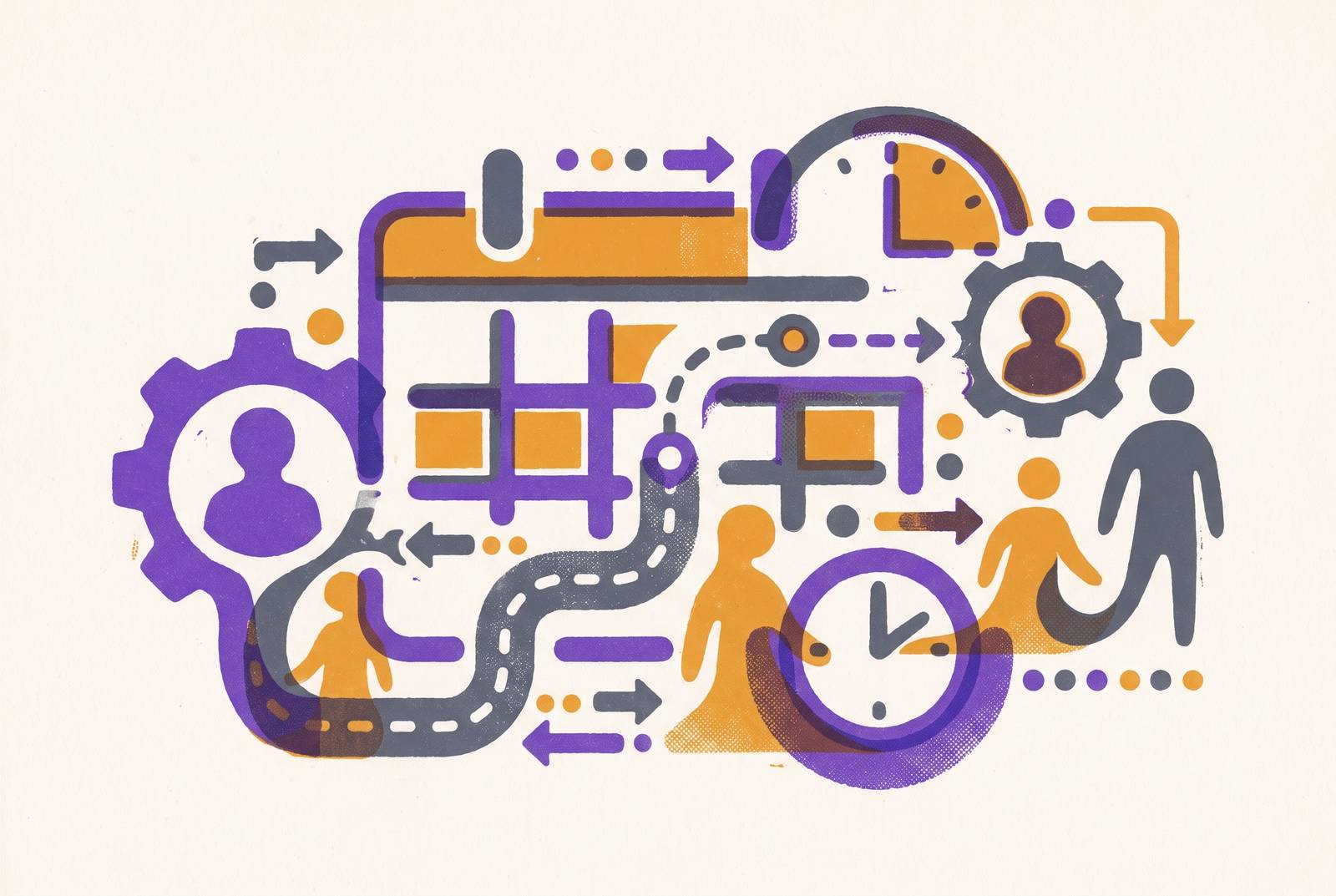
A strong candidate replies to a recruiter's message within a day, maybe two. The role sounds right, the timing works, and the candidate is ready to move. Then nothing happens for a week. No confirmation, no scheduling link, no word on next steps. By the time someone reaches out to set up an interview, that candidate has either taken another offer or stopped checking the inbox. This is the sourcing-to-assessment interval, and it is where hiring funnels lose their best people, not their weakest ones. Most hiring budgets go to the two ends of the funnel: tools that find candidates, and tools that evaluate them once they arrive. The middle, where scheduling happens, where confirmations go out, where a candidate waits to hear back, gets almost no deliberate design. It runs on whatever time a recruiter has left over, which on a busy week is not much. Every task in that stretch, confirming an interview, sending a status update, rescheduling around a conflict, reads to the team as administrative. To the candidate, each one is a signal about whether the company is paying attention. Scheduling in particular is one of the most consistently frustrating points in the entire hiring process, slow for the team to manage and maddening for a candidate stuck waiting on a reply. A candidate who hears nothing after applying draws the only reasonable conclusion available: the role has moved on without them. Many act on that conclusion immediately, accepting another offer or simply redirecting their attention elsewhere, long before anyone on the hiring side realizes a strong candidate has gone quiet.
How scheduling latency compounds into offer-stage risk
Every day that passes between sourcing contact and a first interview is a day a competing employer can close the gap. The candidates most likely to vanish during that stretch are often the ones worth the most effort to keep: passive candidates who took the unusual step of responding to outreach, people who applied on a hunch despite an unconventional background, and in-demand candidates already deep in conversation with other companies. Traditional scheduling works against all three. An email goes out proposing times, the candidate replies with a conflict, another email goes out, and days pass while nothing moves forward. In a hiring market where candidates are fielding multiple conversations at once, those days are not neutral. They are a direct advantage handed to whichever employer responds faster. Self-scheduling tools close that gap by removing the back-and-forth. Zendesk doubled its interview scheduling capacity from 225 to 445 interviews per week in a single month after adopting automated scheduling. The compounding risk works like this: a candidate not confirmed within a short window of initial contact grows steadily less likely to respond by the time an interview is actually proposed. That candidate rarely rejected the role. The process simply failed to hold their attention long enough to get them to the table. Lean teams feel this most acutely. A founder or a small HR function juggling several open roles at once has no recruiting coordinator to absorb the scheduling load, so every delay becomes a structural feature of the process.
Candidate engagement as a retention lever
What a candidate experiences between first contact and the scheduled assessment is an active, ongoing evaluation of what it would be like to work at the company, running in parallel with the company's evaluation of the candidate. Candidates read communication patterns the way anyone reads behavior: slow responses suggest an organization that cannot keep its own house in order, silence suggests the role has lost priority, and generic form updates suggest a process that treats people as line items. The asymmetry is stark: companies put real effort into crafting the outreach message that gets a candidate's attention in the first place, then frequently go quiet the moment that candidate responds, which is precisely the moment their interest is most fragile and most easily lost. Trust adds another layer of pressure. Pew Research Center's survey of 11,004 U.S. adults found that 66% would not want to apply for a job with an employer that uses AI to help make hiring decisions. The fix runs counter to intuition: consistent, timely engagement, even when it is automated, reads as more attentive to a candidate than inconsistent human follow-up, simply because it does not drop the thread. That only holds, though, if the company is honest about what is happening. Telling candidates when AI is involved, what it is evaluating, and how to reach a human instead reduces drop-off and complaints.
AI scheduling and engagement tools in this gap
Applied AI in this stretch of the funnel does more than take a task off someone's plate. It coordinates a connected sequence of candidate-facing moments at a speed and consistency no manual process can match. From a candidate's side, that sequence includes a scheduling link that shows real interviewer availability, including across time zones and multi-person panels, with no email back-and-forth required. A conflict gets flagged and rescheduled automatically, without waiting on a recruiter to notice and respond. Status updates arrive without the candidate having to ask where things stand. If a candidate goes quiet, a re-engagement sequence treats that silence as a signal to investigate. In some processes, a short structured Q&A begins gathering real information about the candidate before the formal assessment ever starts. Both sides end up working with better information earlier in the process. Calendar integrations and conversational tools now handle this as one coordinated layer, not a set of single-task automations stitched together after the fact. What this layer does not do matters just as much: it does not judge whether a candidate is a good fit, build a relationship with that candidate, or represent what the company's culture actually feels like day to day. Those remain squarely human responsibilities, and the strongest implementations are explicit about exactly where the handoff from AI to person happens. Recruiters who use AI-assisted messaging most often are more likely to make a quality hire than those who use it least, which suggests the engagement layer is improving hiring quality, not just moving candidates through the funnel faster.
How a well-managed middle stage changes who reaches assessment
Speed is the easy benefit to see, but it is not the most important one. When the middle stage runs well, it changes which candidates are still in the pool by the time assessment begins, which affects hiring outcomes more than a faster average time-to-interview does. Think about who disappears during a slow, silent middle stage. It tends to be passive candidates with no urgency to stay engaged, candidates from non-traditional backgrounds who are already uncertain whether they fit and need more reassurance from the company rather than less, and in-demand candidates running several conversations at once who will simply follow whichever process moves first. A process that confirms quickly, communicates clearly, and reaches back out when a candidate goes quiet keeps more of these people in the pipeline, independent of how good the original sourcing was. That retention problem is getting harder to solve by sourcing alone, too. A significant and growing share of applicants now use AI to draft resumes and cover letters, with a smaller but real minority using it for interview responses as well. Résumés and cover letters are starting to look more alike across candidates, which makes it harder to separate genuine fit from a well-optimized application. This is why the middle stage carries more weight now, not less. A short sequence of structured questions or screening prompts before the formal assessment starts generating real signal early, in a way that's harder to fake than a polished resume. As that coordination work gets handled elsewhere, recruiters get to spend their attention on the moments where their judgment about a specific person actually matters, the scarcer and more valuable use of their time. The organizations getting the best results tend to use AI across several stages of the funnel while keeping strategy, relationship-building, and final decisions in human hands. The middle stage is where those two modes meet.
What lean teams, founders and small HR functions gain
For a lean team, a broken middle stage does not just slow things down. It quietly biases every hire toward whichever candidates happened to be the most persistent, which is a very different thing from the most capable. At an early-stage company, the founder is often the hiring manager, the closer, and the person sending the follow-up emails, all at once. That coordination load does not scale, and it crowds out the one thing only the founder can actually do: judge whether a candidate is right for the role. Without a recruiting coordinator or a structured engagement system, the middle stage defaults to whoever happens to have a spare hour that day. The candidates who stay engaged are often just the ones who reached out at a convenient moment, not the ones best matched to the job. AI in this context exists to take the time-consuming manual coordination off a founder's plate so that judgment has somewhere to go. For most lean teams, that means a fairly clean division of labor: AI handles confirmations, status updates, rescheduling, re-engagement when a candidate goes quiet, and preliminary screening questions, while the founder shows up for the two or three conversations where culture, judgment, and a candidate's real interest in the company are genuinely being tested. Transparency does real work here too. A clear signal that AI handles coordination while a human makes the actual call tends to build more trust with strong candidates, not less, because it tells them exactly where to expect a real person in the process. There is a quieter benefit as well. A structured engagement sequence produces consistent data about how candidates respond, what they say, and where they drop off, which a founder juggling five open roles from memory simply cannot track on their own. Without that data, there is no way to know what part of the process is actually working.
Evaluating whether your middle stage is the problem
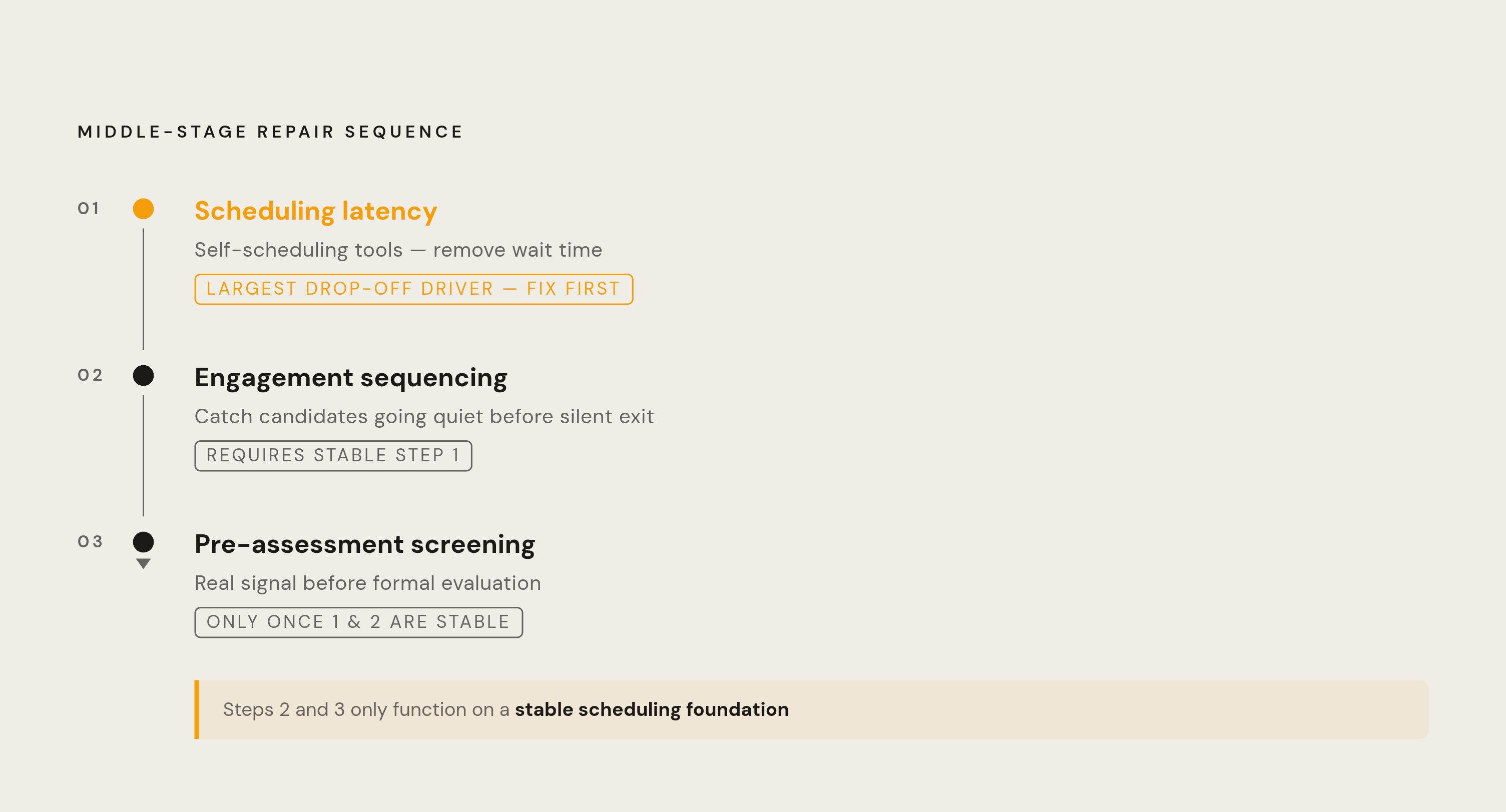
Most teams cannot diagnose a broken middle stage because they are not measuring it. Visibility has to come before any fix. A few questions reveal a lot quickly. How long, on average, does it take between first sourcing contact and a scheduled first interview, and does that number shift by role, by team, or by recruiter? At what point do candidates actually go quiet: before scheduling, after scheduling but before the interview, or somewhere in between? What do candidates actually hear from the company during that stretch, and is it the same message for everyone or does it depend on who happens to be handling that file? How many rescheduling requests get handled by hand, and how much time does each one add to the overall timeline? A team that cannot answer most of these questions is running its middle stage on intuition, and intuition tends to badly underestimate how much candidate attrition is happening before anyone sits down for an assessment. Fix order matters. Scheduling latency comes first, since it is usually the single largest driver of drop-off and the most directly solvable with self-scheduling tools. Engagement sequencing comes next, to catch candidates who do not respond right away before they fall out silently. Structured pre-assessment screening comes after that, once the first two are stable, to start generating real signal before the formal evaluation begins. For smaller teams, the right move is usually the smallest system that keeps the pipeline visible, meaning clear statuses and scorecards, and reduces back-and-forth, not the most elaborate platform on the market. The goal is closing the specific gaps that are actually losing candidates, not maximizing sophistication for its own sake. None of this removes the human role from hiring. It relocates that role to the moments that actually require judgment, relationship, and a company's own specific sense of what a great hire looks like. A unified system that connects sourcing, middle-stage engagement, and assessment, rather than three separate tools passing candidates between them, puts every change to the hiring process somewhere a team can actually see it, question it, and improve it over time. That is the direction the broader conversation about AI in hiring is heading, and the middle stage is where it will be decided first.