Limitations of AI in Evaluating Culture and Values Fit
AI struggles to assess values alignment but excels at consistency.
AI hiring tools can now score a resume with something close to 94% accuracy. Asking that same system to predict whether someone shares the company's values drops accuracy to 76%. That gap is not a rounding error. It's the entire argument for why AI can help a hiring team make a decision about values fit, but it should never be the one making the call.
The rest of this piece is about why that gap exists, where it appears in practice, and what a hiring process looks like when it's designed around that limit instead of ignoring it. One scope note first: this is about early- and growth-stage teams making hires that matter, not high-volume frontline screening where the math and the stakes look different.
What "culture fit" means, and why the concept resists operationalization
When a hiring manager is asked why a candidate didn't get an offer, "wasn't a culture fit" comes up constantly. When that same manager is asked to define the criteria they used, things get vague fast. That's because "culture fit," as a term, is almost never operationalized. It's a gut call dressed up as a conclusion.
Historically, that gut call has done a specific kind of damage. "Culture fit" has functioned as a polite way of saying "hires people who look, sound, and think like the people already here." Similarity bias, wearing a name tag that makes it sound like a hiring principle.
The fix isn't to throw the concept out. It's to replace it with something you can actually observe: values alignment. Instead of asking whether a candidate feels right, values alignment asks whether their demonstrated behavior lines up with specific, written-down principles the company actually holds. Take a value like "integrity." On its own, that word is too abstract to score anybody against. But turn it into "owns a mistake and communicates a recovery plan," and now you've got something an interviewer can actually listen for and grade.
AI can only optimize for what's been specified. If "culture fit" stays vague inside the organization, whatever AI tool gets bolted onto the hiring process just inherits that vagueness. It doesn't produce a clean signal. It produces confident-sounding noise. The vagueness itself produces the confident-sounding noise, not the AI. A system fed an undefined target falls back on the only pattern available to it, which is resemblance to whoever got hired before. That means whatever bias shaped those past hires gets encoded right back into the "prediction."
How AI generates false positives and misses non-obvious candidates on the values dimension
Given that ambiguity, AI screening tends to fail in two specific and opposite directions.
The first is the false positive: a candidate who's polished on every surface signal, clean communication style, recognizable school, known employer brand, well-formatted answers, but whose actual values run in a different direction than the team's. The second is the false negative: a candidate whose answers don't pattern-match to what past hires looked like, even though their actual values line up fine. Both failure modes are well-documented patterns in how AI screening systems behave in practice.
Both failure modes share the same mechanical issue. Tools built to reward resume signals reward familiar titles and known employer names. Those aren't evidence of how anyone behaves under disagreement or ambiguity, they're just credentials. And because the training data behind these models is built from past hiring decisions, any systematic preference baked into those decisions gets reproduced and relabeled as "fit." A University of Washington test found AI resume rankers favored white-associated names 85% of the time, revealing historical bias wearing new software. That's not values alignment. That's historical bias wearing new software.
A second layer sits on top of all this: fake signal. Gartner projects that by 2028, roughly 1 in 4 candidate profiles worldwide will be fake, and a significant share of candidates already use AI to draft their resumes and assessment answers. So the very inputs AI tools read to make a fit judgment are increasingly manufactured, not organic. And only about 26% of candidates say they trust AI to evaluate them fairly, which shapes behavior on the other side of the table too: distrust breeds gaming, evasive answers, extra polish. Which degrades the quality of what AI has to work with even further.
Why the qualities that define values alignment are structurally hard for AI to read
What actually predicts whether someone thrives on a team looks different. None of it sits neatly in structured data.
Emotional intelligence, reading a room, adjusting tone mid-conversation, managing conflict without escalating it, isn't visible in an application or a keyword match. Adaptability becomes visible when plans change or feedback stings, and that only reveals itself through live interaction or a documented behavioral track record, not a form field. Leadership presence and collaboration style are visible in dynamic, multi-person settings; they don't appear in a solo written assessment. Growth mindset gets observed through how someone actually responded to failure over time, and that's rarely something resume language captures well.
These traits are, by nature, better evaluated through conversation and real interaction than through a scored form. AI can build proxies for them, but proxies are approximations, not observations.
Even the newest AI voice screening tools, which can now hold a natural-sounding conversation, follow up intelligently, and handle some ambiguity, run into a hard ceiling here. A candidate talking to an AI interviewer knows they're talking to an AI interviewer. That awareness shapes the performance. The classic "tell me about a time" prompt captures a story about the past, sure, but whether that same behavior appears in a brand-new team, under a brand-new set of pressures, depends on context no training model built for a different company ever had access to.
And the candidate pool an AI interview actually reaches is already skewed. Something like 38% of job seekers say they've walked away from a hiring process specifically because it included an AI interview. Whatever data that screen produces is data from the subset of candidates who stuck around, not the full pool.
AI reads what candidates say, and that is its real limit. It doesn't read what they leave out, how they handle a moment of genuine uncertainty mid-conversation, or whether the self they're presenting now still looks the same six months into the job.
Where structured AI tools do add genuine value in the values-assessment process
None of this means AI has no place in the process. It just means the place is narrower and more specific than "predict culture fit" suggests.
Consistency at scale is real and valuable. AI screening applies the same criteria to candidate two hundred as it does to candidate one, which is more than most recruiters manage by hour four of resume review. Structured prompts paired with rubric-based scoring cut down on similarity bias, provided the rubric is built around named behaviors instead of vague impressions. Name four to six values as behaviors, write prompts that ask for evidence, score against a described anchor for each level, and blind the first pass to anything that isn't the actual answer.
There's also real evidence AI finds people a resume-only screen would have missed. There is real evidence AI finds people a resume-only screen would have missed. Sentiment analysis and interview transcription build an evidence trail too, something most human interviewers never bother producing on their own, and that trail helps with calibration across interviewers over time. It can also catch contradictions a rushed human screen might not: if a candidate's stated values in one prompt don't square with how they describe handling a specific situation in another, structured scoring makes that gap visible instead of letting it slide by unnoticed.
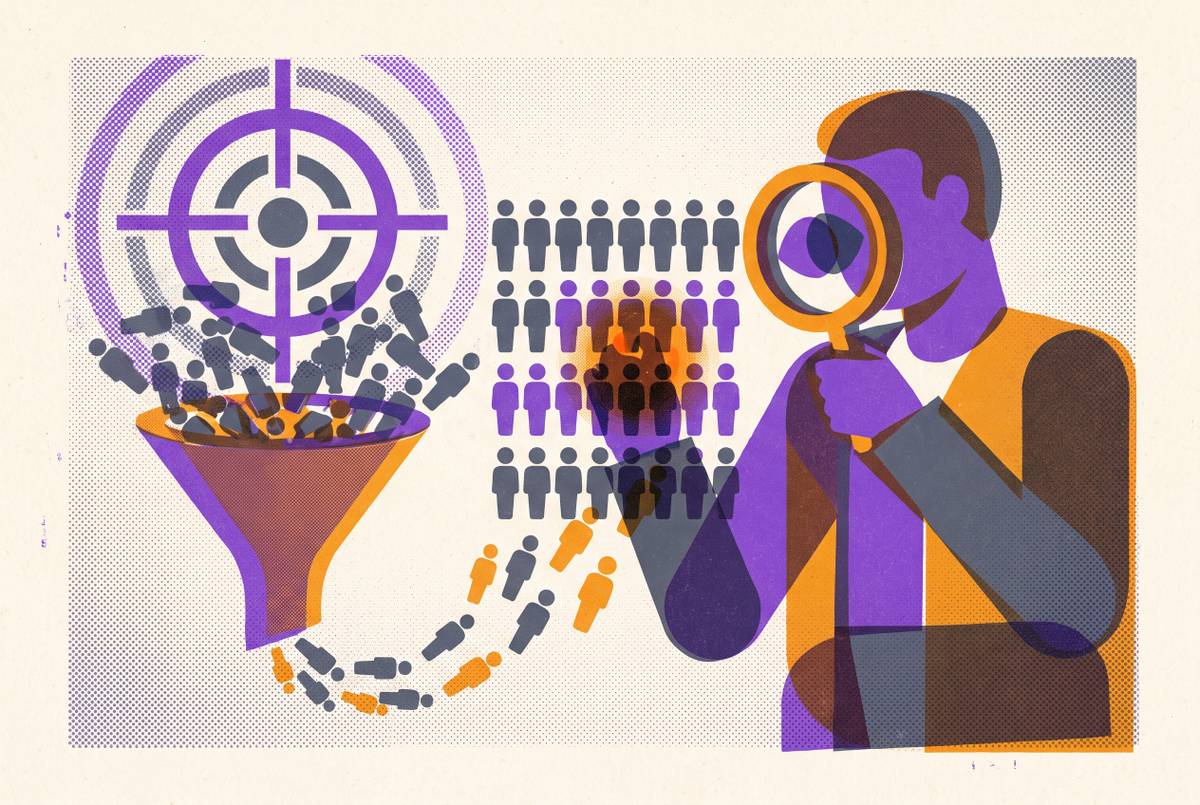
The strongest use case is narrowing. AI takes a noisy, high-volume pipeline and turns it into a smaller set of people worth an actual conversation. That's the shift underway heading into 2026: smaller pipelines of better-matched candidates, so recruiters spend their limited hours on real contenders instead of maybes.
What none of this solves is the actual verdict. AI-assisted first-pass screening still can't tell anyone how a person's values will hold up under pressure, in conflict, or inside the specific relational texture of one particular team.
What happens when calibration is missing, why "culture fit prediction" without a defined standard is noise
An AI system that can't be recalibrated per role and per team can't encode what "exceptional" means inside that specific context. It just imports a generic market signal and presents it as a company-specific judgment.
There's an early warning sign that a screening process has drifted into vibes instead of evidence: watch the specificity of the rejection reasons. Once interview notes start reading "not a fit" or "communication issues" with nothing backing it up, the rubric has already dissolved, whether anyone's noticed yet or not.
Good calibration looks different. It pairs a competency label with an actual evidence snippet, so a score always comes attached to the reasoning behind it. That way, drift becomes visible immediately instead of accumulating silently over a hundred hires. And the thing that actually improves an AI-assisted process over time is feedback from hiring managers on how closed hires turned out. A system that can't learn from that loop just stays static, repeating the same pattern-match indefinitely.
In Korn Ferry's 12th Annual Talent Acquisition Trends survey, 73% of talent acquisition leaders said critical thinking and problem-solving is the skill they most need heading into 2026. AI skills ranked fifth. The judgment layer sitting above the tool matters more than the tool.
For a lean team without a defined behavioral model, "culture fit" scoring from AI is just pattern-matching against whoever got hired last time, which, if nobody wrote down why those hires worked, might have been guesswork the first time around too. A properly calibrated system makes every adjustment to the standard visible and explainable. A black-box score a hiring manager can't question or override is the opposite of that.
The regulatory and trust pressure pushing culture-fit AI toward human oversight
Regulation is starting to draw a hard line around exactly the kind of tool that claims to measure cultural alignment through sentiment or emotional signal. The EU AI Act banned AI systems that recognize emotions in the workplace starting February 2, 2025, which lands directly on tools built to read affect as a proxy for fit. Broader EU rules covering AI hiring tools take effect from December 2, 2027, after a delay agreed in 2026. Any hiring team building AI-assisted values assessment now is building toward a standard that will require explainability and a human in the loop.
Colorado's replacement AI law gives a rejected applicant the right to request human review of the decision, which opens up a new category of legal exposure for any system that lets AI reject candidates on cultural grounds without a person signing off.
Candidate expectations are already ahead of most companies' actual disclosure habits. 87% of US job seekers say employers should be upfront about their AI use, and 46% want the option of a human interview somewhere in the process. Meanwhile, only 18% of recruiters surveyed in Aptitude Research's State of the Recruiter Experience report said the technology they use actually supports their real work. The tools have outpaced the workflow design needed to use them responsibly.
That mismatch also raises a trust problem. 25% of candidates say they trust an employer less once they learn AI is evaluating them, and 46% say their overall trust in hiring has dropped. A process that alienates strong candidates before it's even evaluated them is working against its own purpose.
All of this, the regulation and the trust data, points toward the same conclusion. Keeping a human decision at the center of the values verdict isn't a compliance checkbox. It's where the process has to land regardless.
How to design a process where AI assists and humans decide on values fit
Start with the behavioral model, not the software. Before picking any AI tool, name four to six values as specific, observable behaviors. "Integrity" has to become "owns a mistake and communicates a recovery plan" before anything can score against it fairly.
Let AI run the first pass on evidence-seeking prompts: open-ended scenario questions, scored against a rubric with clear descriptive anchors (a 1 through 5 scale running from Insufficient to Exceptional works fine), blind to name, school, photo, and location. But define AI's job precisely: it's filtering out clear misalignment, not confirming that someone's a fit. The actual verdict on fit belongs to a person who can sit with the whole candidate, not a score.
That human interview has to do work AI structurally cannot:
- Watch how the candidate handles surprise, pushback, or genuine ambiguity as it happens, in real time
- Notice whether the person in the application matches the person actually in the room
- Judge team-specific relational dynamics: would this person make the people around them better at their jobs
- Own the call, and the accountability that comes with owning it
Close the loop afterward. When a hire works out, or doesn't, write down which behavioral signals actually predicted the outcome. That's the calibration data that sharpens the AI layer over time and keeps the standard evolving instead of freezing in place. Every time the rubric shifts, that shift should be a deliberate human decision with a documented reason, not quiet drift in an AI scoring weight nobody's watching.
Only a small share of recruiters say they're very confident their systems aren't rejecting qualified candidates. That uncertainty, on its own, is the case for keeping the final values-fit call in human hands, with AI gathering evidence that supports rather than makes the decision itself.
For early- and growth-stage teams specifically, the math is harsher than it looks. A values misalignment in a ten-person company costs a lot more than the same misalignment buried inside a thousand-person one. The smaller the team, the more that human judgment layer matters: a values misalignment costs more to hand over to a tool built for pattern-matching at scale.