Recruitment Automation Tools Mapped to ATS Workflow Stages
Match automation tools to workflow stages to avoid wasting high-potential candidates early on.
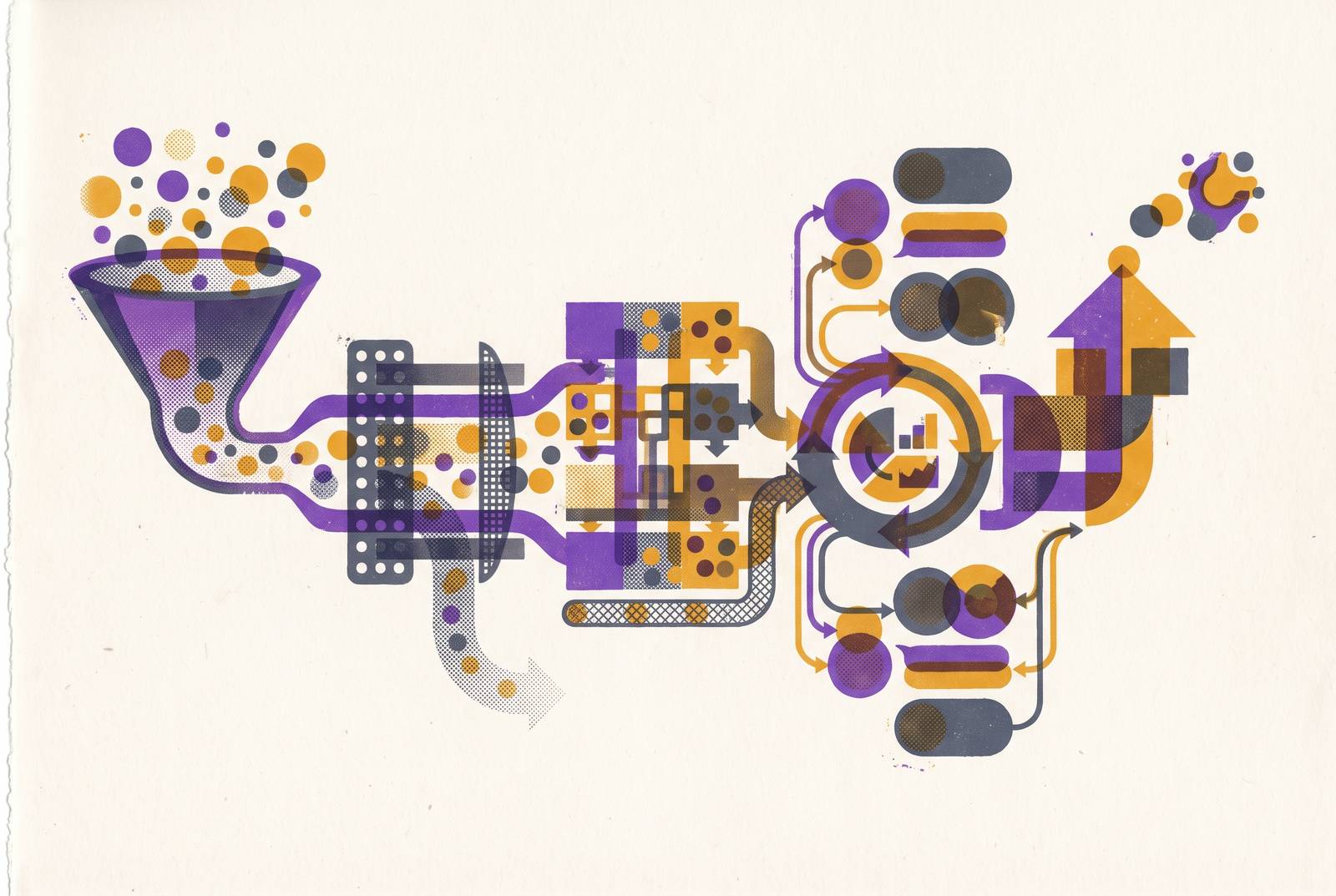
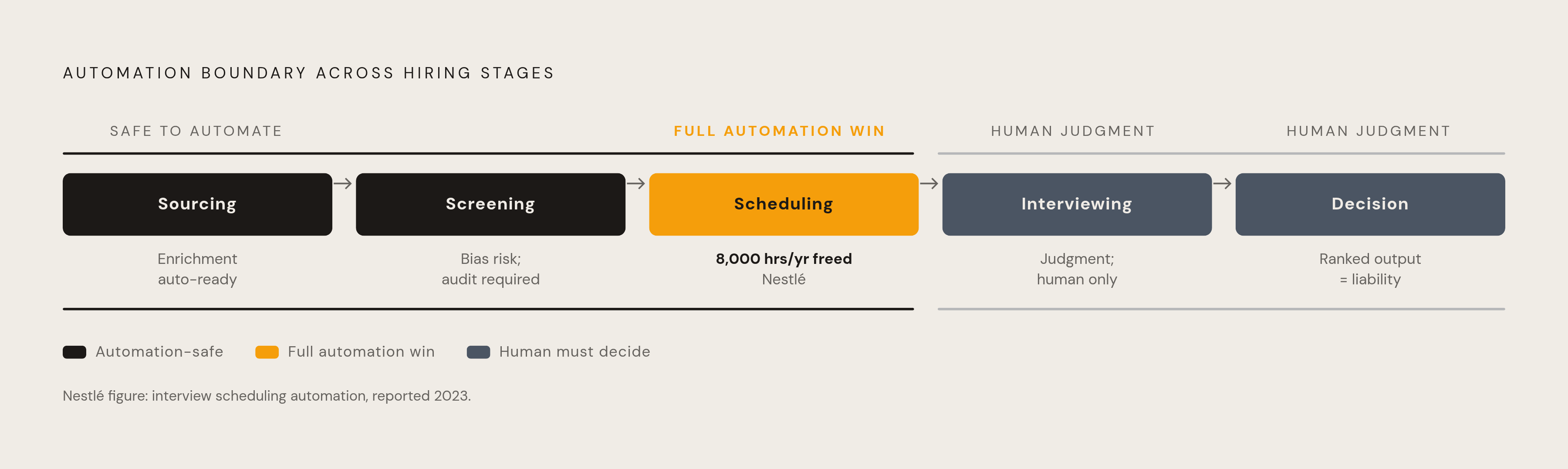
Most recruiting teams have added AI tools over the past two years. The gap isn't about weak tools. A recruiting stack built around five distinct workflow stages, sourcing, screening, interviewing, scheduling, and decision, works because each stage calls for a different kind of automation, and mixing them up turns signal into noise.
The technology behind agentic tools has changed fast, which raises the stakes when those tools act on bad advice. An assistive tool that gives bad advice gets ignored. If an agentic tool acts on bad advice, it has already sent the email, scheduled the interview, or rejected the candidate before anyone notices.
The practical split that follows is simple. Mechanical stages, sourcing enrichment, resume parsing, scheduling, follow-up, are safe places to hand control to a machine. Teams that get consistent results apply AI selectively, and humans hold onto strategy, relationships, and the final call.
The ATS workflow before automation
Before you decide where automation belongs, it helps to see the workflow as five distinct stages, each with its own job. Each stage has a different input, a different output, and a different risk if it's done badly.
Older applicant tracking systems were little more than a passive resume database, so they matched keywords and not much else. What counts as an ATS today is a different animal: semantic skill inference instead of keyword matching, calendar integration that books interviews without a human touching a calendar, predictive match scoring, bias detection that can be audited after the fact, and real-time alerts when a pipeline stalls. More capability means more ways to apply it badly.
The handoffs between stages are where delays build up. And because pipeline conversion from application to hire is low industry-wide, small gains early in the funnel tend to produce outsized gains in hire quality and speed later on.
Sourcing stage: automation tools that find candidates beyond the obvious pool
Sourcing is where automation shows its clearest wins, but only when the tool is actually doing semantic search instead of matching the same familiar job titles and brand-name employers a recruiter would type into a search bar anyway. The underlying problem with sourcing has never really been about volume. It's about proxies. Recruiters search for job title, employer brand, and degree because those are easy to search for, not because they're the best predictors of fit. An AI sourcing tool built on those same proxies just replicates the same bias, faster.
What should a sourcing tool actually find? Candidates whose skills show up in the work itself: portfolios, project write-ups, open contributions. Vervoe's 2026 analysis describes AI sourcing scanning internal databases, archived ATS records, sourcing CRMs, social profiles, and passive talent pools to find high-potential candidates before a role is even posted. Sourcing stops waiting for applicants and starts going out to find them.
A few tools illustrate what this looks like in practice. Workday's Recruiting Agent, unveiled in September 2024, sources passive candidates, runs outreach, matches talent, and schedules interviews alongside human recruiters inside Workday's existing HR ecosystem.
Lantern approaches this stage from a different angle. Recruiterflow notes that sourcing is the task recruiters say they'd automate first, ahead of scheduling, follow-ups, and reference checks combined. That makes it the highest-priority stage to get right, and also the stage where getting it wrong costs the most downstream.
Calibration: the step that determines whether sourcing and screening automation surfaces the right people
No sourcing or screening tool can find the right candidates if nobody defined "right" with any precision first. Calibration is the step where you build that definition, and you do it before a single candidate gets evaluated. Skipping it, or doing it badly, means every tool downstream inherits the mistake.
What does calibration actually involve? Identifying exemplar candidates: people currently succeeding in the role, people who succeeded in it previously, and comparable past applicants, then using that set to build a profile the system can match new candidates against. That profile draws on HR data, public sources, and proprietary data, and it becomes the yardstick everything else gets measured by.
Two existing products show how this mechanic works in practice. Greenhouse's Talent Matching lets recruiters set criteria, skills, experience, job titles, optionally industry, and assign each one an importance weight. The Workable Agent, announced March 13, 2026, goes further: it sources passive candidates, screens every applicant, scores each person out of 100 against an Ideal Candidate Profile with written reasoning attached, and marks each criterion as met, partially met, not met, disqualifying, or unknown. The ICP has to be built before the job goes live, but Workable lets a team add, edit, or remove criteria after the job is published, and the Agent re-evaluates every candidate against the updated profile.
Lantern's version of this runs on a fifteen-minute calibration session that produces a living profile that sharpens with every round of interview feedback. Every change to that standard stays visible and requires a human to approve it.
The most common way this goes wrong isn't a bad tool. A second failure sits further upstream, in the job description itself. Good calibration should also push back: if the profile describes a candidate the talent market genuinely can't supply, the system should say so before the search starts, not three weeks into a search that was never going to work.
Screening stage: speed gains and false positives
Screening automation can process applications at a volume no human team can match. Screening automation processes applications at volume, but whether the resume it reads still means what it used to is the harder question.
At its best, AI screening parses applications for actual skills and demonstrated experience, surfacing candidates with non-traditional paths who'd get filtered out by blunter rules. A resume that looks perfectly aligned to the role no longer reliably means the candidate is.
That cuts both ways, and both failures cost something real. If a company's past hires skewed toward one credential profile, the tool learns that pattern and calls it a match score.
The fix connects directly back to calibration. Moving from "did this person hold the title?" to "can this person demonstrate these five skills at this level?" widens the pool a screening tool can reach and cuts down on credential-proxy errors. Assessment tools, covered in the next section, plug into screening directly. Lantern's approach reflects this same shift: screening for evidence of what a candidate has actually built, rather than where they worked or what their title was, is the operational version of a skills-first standard.
Interviewing stage: AI tools that standardize evaluation without replacing interviewer judgment
At the interviewing stage, the most valuable automation standardizes the structure around the interview and calibrates how interviewers behave, so human judgment gets applied consistently instead of varying by whoever happens to be in the room.
Asynchronous, one-way video interviews are one version of this. Because every candidate gets the same questions and the same prep time, the format standardizes evaluation, and it cuts out a lot of the scheduling friction that slows down early screening. In both cases you want a faster, better-informed decision, not an automated verdict.
Lantern runs AI interviews as part of its full hiring loop, paired with technical assessments, and the output is evidence handed to the hiring manager, not a hire or no-hire call made on the candidate's behalf. The human still reviews that evidence and makes the decision. Vervoe's 2026 analysis speaks directly to assessment quality here, and it reinforces the same point: the tool's job is to produce better evidence, not to replace the person reading it.
Compliance is tightening around this stage specifically. OneWayInterview's 2026 report flags NYC's Automated Employment Decision Tools requirements and the EU AI Act's high-risk employment category as baseline considerations you need for any tool that touches evaluation. AI at the interview stage should produce structured evidence for a human decision-maker, not a ranked output that functions as the decision itself. A substantial majority of recruiters say they want to keep final decision authority over AI recommendations, and the regulatory direction is reinforcing that preference.
Do one-way video interviews hurt candidate experience? Being clear with candidates about what the AI is evaluating, and giving them a way to request a human alternative, cuts down on drop-off at this stage.
Scheduling stage: the highest-return automation in the ATS workflow
Scheduling is the one stage where full automation makes sense, because it involves no judgment about the candidate. It's pure coordination, and the time saved is immediate and easy to measure.
AI scheduling tools read availability across every interviewer involved, propose times to the candidate, handle reschedules when something changes, send calendar invites, and trigger reminders, all without a human coordinator managing any of it by hand. No quality judgment is buried in any of that. The only variable is logistics, and logistics is fully solvable once the constraints are known.
The scale here is already proven out. Nestlé's automated scheduling frees an estimated 8,000 admin hours a year. Those aren't small pilots: they're evidence that the time savings hold up at enterprise scale.
Lean teams and founders stand to gain the most from this, proportionally, because every hour of scheduling reclaimed goes straight back into the work a machine can't do: building relationships, exercising judgment, negotiating an offer. Lantern handles scheduling as part of its full-cycle loop, so coordination never needs its own separate tool, the same system running sourcing, screening, and AI interviews handles it directly.
Decision stage: what automation can prepare but humans must own
The decision stage is where every piece of evidence gathered at the earlier stages gets handed to a person. It's also the point where a tool that tries to make the call instead of supporting it turns from automation into a liability.
Good tooling at this stage pulls together structured evidence from sourcing, screening, interviews, and assessments, so a hiring manager can actually act on it quickly. It surfaces the reasoning behind a recommendation, not just a score, and it makes the basis for every recommendation something that can be checked and explained later. What it should never do is produce a ranked output that functions as the hiring decision itself, or quietly remove the hiring manager from judging whether someone actually fits the team's standard.
Recruiterflow's 2026 analysis draws the line in roughly the same place: the work that stays human is the judgment-heavy part, the final hiring decision, the relationships, the advisory calls that require context a model doesn't have. The broader trend, by that same analysis, is that AI absorbs transactional work while people keep ownership of decisions. Lantern's model follows that same logic: it delivers people worth meeting along with the evidence behind each one, and the hiring manager reviews that evidence and makes the call. Every change to the underlying hiring standard stays visible and needs human approval.
Regulation is pushing in the same direction. NYC's Local Law 144 is still the most detailed AEDT requirement in force now. Across all three, you now need documentation and auditability as compliance necessities, not just optional good practice.
If AI has handled everything up to this point, why not let it make the final call too? Taste, relationship context, and organizational judgment all converge at the final decision, and if you automate that convergence, you lose what separates an exceptional hire from a merely qualified one. As AI agents take over more of the execution work, a new kind of role is emerging around them: people whose job is managing those agents, setting the standards they operate against, interpreting the evidence they produce, and making the final call, and Recruiterflow's 2026 analysis describes this as the direction the recruiter role itself is heading, toward more concentrated judgment.
Auditing your current stack against these five stages
A useful audit doesn't just flag which stages are under-automated. It also catches which stages have been over-automated in ways that are quietly degrading signal quality.
Next, find where the actual bottleneck sits. Whichever stage is slowest is where you get the most out of adding automation. OneWayInterview's 2026 guidance for small and midsize businesses is to buy the smallest stack that keeps the pipeline visible and cuts down on back-and-forth, adding AI only where it removes a real bottleneck, not where it looks impressive on a vendor page.
Then check for false positives. If interviewers keep reporting that screened candidates aren't meeting expectations once they're in the room, the screening stage is producing false positives, and the fix is upstream calibration work, not a newer screening tool. Check for false negatives too: if sourcing keeps returning a narrow, credential-homogeneous slate of candidates, the sourcing criteria is encoding proxies instead of skills, and the fix is semantic search paired with a calibration rebuild.
Finally, audit the decision stage for automation creep. Restoring the habit of reviewing evidence before deciding is the fix.
A collection of best-of-breed tools, one per stage, tends to create handoff problems between stages even when each individual tool works well. The same coordination friction scheduling automation removes within a stage tends to reappear between stages when the tools don't share a data model. You can weigh that fragmentation against one system that runs the full loop on a single calibrated hiring standard. Lantern is built around that idea specifically: sourcing, AI interviews, technical assessments, scheduling, and candidate engagement all run from one calibrated standard, and the hiring manager receives only people worth meeting along with the evidence needed to judge them, rather than five separate tools that each need to be taught the same thing from scratch.