Structured Hiring Process for Technical Co-Founder Searches
Align your team on the role before you start sourcing to avoid restarting the search.

Most technical co-founder searches don't fail because the right person is missing. They fail because the founding team never agreed on what the role actually requires. That disagreement surfaces late, after weeks of outreach, and the search restarts. The cost of that restart is higher now than it has ever been.
Why technical co-founder searches fail before sourcing starts
The pattern is familiar to any founder who has run one of these searches. You write a job description, post it, talk to twenty candidates, and discover in week six that the board member and the CEO have different ideas about what "technical co-founder" means. By the time the gap becomes visible, the timeline is gone and the strongest candidates have accepted other offers.
Calibration failure is the root cause, not candidate scarcity. The talent market makes the stakes concrete: technical engineering hiring is running above its 2019 baseline while the overall tech market remains below it. A founder who enters that market without a shared, written definition of the role is negotiating from a position of confusion, not strength.
The fix is structural, not motivational. A calibration session that forces disagreement into the open before sourcing begins, a scorecard that encodes what the company actually needs, and an evaluation process that tests evidence of what candidates have built rather than credentials they hold. Each section that follows addresses one failure point in this chain.
How the technical co-founder role actually differs from a senior engineering hire
A technical co-founder is not a senior developer with a better title. Confusing the two leads to the wrong scorecard, the wrong sourcing pool, and the wrong equity offer from the start. The distinction is the foundation every subsequent calibration and evaluation decision rests on.
The founding engineer archetype has characteristics a senior developer may lack. A senior engineer can be excellent at two of these and still be the wrong person for a founding role. The person who thrives as a technical co-founder treats the company's outcome as their own, not as a project they've been assigned.
There is also a signal effect at work. A non-technical founder convincing seasoned technical talent to leave a well-paying job for equity is itself one of the strongest positive signals an investor can see. If a technical co-founder receives a token stake, investors conclude either that the person isn't strong or that the founder doesn't understand what technical capability is worth.
The practical consequence is that red flags belong in the rubric now, before sourcing starts. These are not interview observations to note and set aside. They are disqualifying signals that belong in the written standard.
Matching the CTO archetype to your company's stage before writing the brief
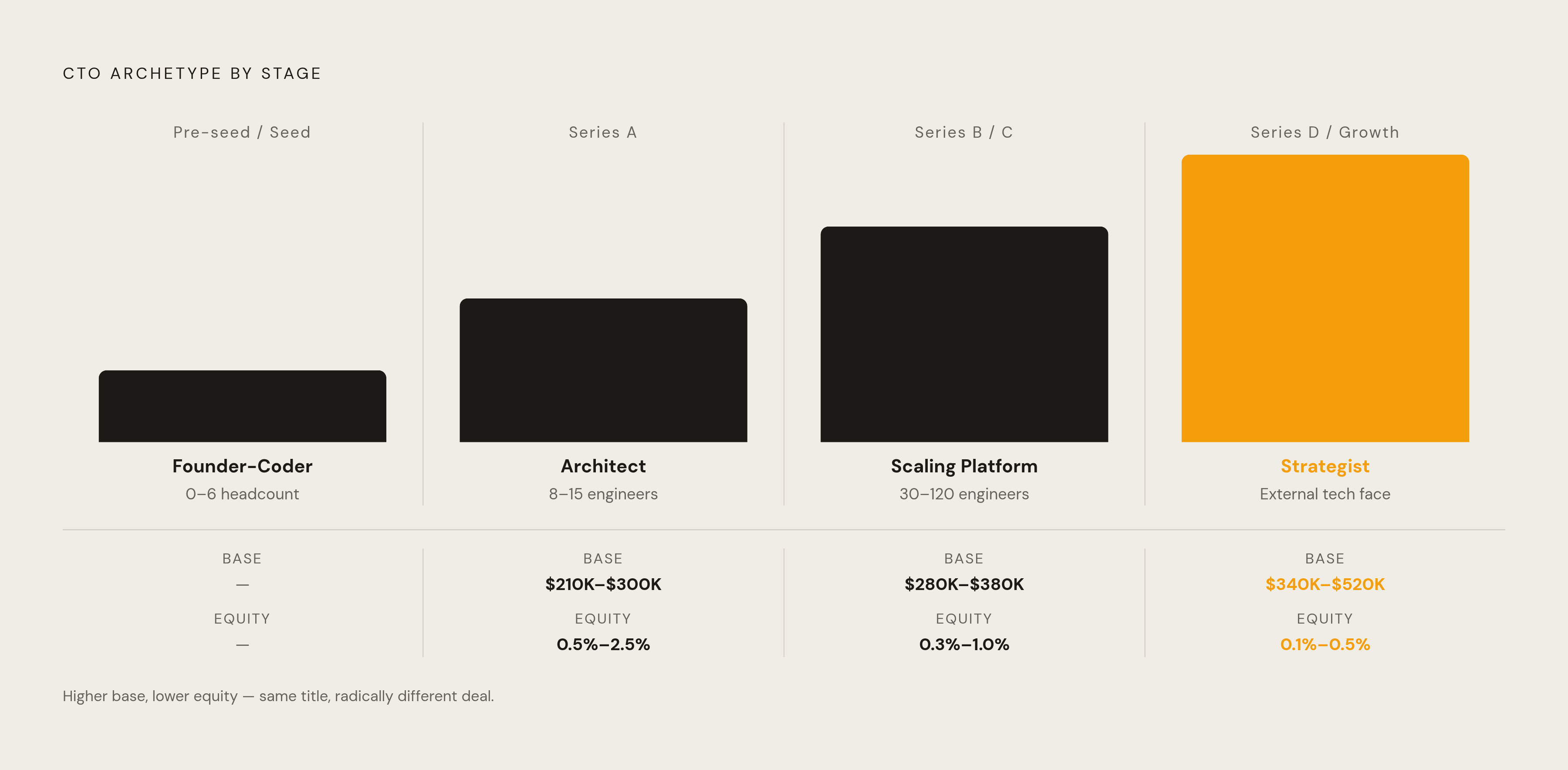
The CTO title covers at least four meaningfully different jobs, and writing a brief without first naming which one you need is the mechanism by which searches restart. Stage determines archetype. Archetype determines comp band, sourcing pool, and evaluation criteria.
At pre-seed and seed, the Founder-Coder CTO builds v1, writes most of the code, owns architecture, and manages a headcount of zero to six. At Series A, the Architect-CTO sets platform decisions that will be hard to undo, hires the first eight to fifteen engineers, and still writes code thirty to fifty percent of the time. Base comp lands between $210K and $300K, equity between 0.5% and 2.5%.
Series B and C call for a Scaling Platform CTO: someone running thirty to one hundred twenty engineers across multiple pods, building an engineering leadership bench, and owning reliability and enterprise trust. At Series D and growth stage, the Strategist CTO becomes the external face of technology, handling customer escalations, analyst briefings, and M&A integration. Base reaches $340K to $520K, with equity at 0.1% to 0.5%.
The most common misread is calling for a CTO when what the company needs is a VP Engineering plus a head of architecture sitting beneath a technical CEO. Hiring a "CTO" in that environment produces a year of friction and a quiet departure. The distinction between a technical co-founder and a first engineering hire also governs what the role evolves into. As the company grows, the co-founder shifts toward hiring engineers, setting technical direction, and translating customer feedback into product decisions, per CRV. Once you've named which archetype you need, the sourcing and evaluation criteria shift accordingly. An end-to-end AI recruiting system like Lantern adapts its sourcing pool and assessment logic to the stage-specific definition of exceptional you've locked in, rather than running every technical co-founder search through the same template.
Running a calibration session that produces a usable hiring standard
A calibration session is not an intake meeting. It is a structured debate among stakeholders that forces disagreement into the open before the search starts, rather than in week six. Two questions get answered aloud: what does this person own in the first ninety days, and what does failure look like?
Why does this format matter? Because the CEO's definition of ambiguity tolerance may differ sharply from the board member's. Those gaps must resolve before you contact a single candidate. Lantern is built around this insight: it locks in what your company is actually searching for in a structured fifteen-minute session before any sourcing begins, making hidden disagreements visible and resolvable before weeks of wasted outreach.
The calibration must also address what the technical co-founder needs to see in the company before committing. The output of this session is a scorecard with specific ownership criteria, not a job description with a list of skills. That scorecard frames every subsequent sourcing and evaluation decision.
Reading the talent market before setting a timeline or comp band
Founding engineer candidate supply is structurally tight, and founders who set timelines and comp bands without market intelligence routinely lose finalists to competing offers. The sub-market a technical co-founder search targets, senior AI-literate full-stack builders, is tighter than the overall tech market. Technical engineering hiring recovered above its 2019 baseline while overall tech hiring remained below it, per TechTree's Global State of Tech Talent 2026 data.
The AI-literacy dimension is now a sourcing constraint, not a preference. Job postings requiring AI coding tool experience rose sharply between January 2025 and January 2026, while postings for pure implementation roles declined. A technical co-founder search in this environment is effectively an AI-capable founding engineer search. That narrows the pool further and raises the cost of a calibration failure.
Finalists in this pool typically field multiple competing offers simultaneously. Equity terms and founder chemistry decide outcomes more than base salary. Remote hiring offers a counter-lever for founders outside major markets. Geography is a sourcing constraint that remote hiring partially dissolves.
How to replace a fragmented recruiting stack for a technical co-founder search
The channels that produce technical co-founder hires are ranked by relationship depth, not by reach. Treating high-volume sourcing methods as primary wastes the timeline that market speed demands. HyperNest Labs' founding engineer guide ranks the channels in order of effectiveness.
Personal networks account for the large majority of successful hires. Investor networks come next: angels and lead investors often know engineers looking for their next opportunity, and asking every investor for three engineer introductions is a concrete ask. Technical communities round out the hierarchy, open-source contributors in your specific domain, conference speakers, and niche Slack and Discord communities, where signal quality runs higher than generic job boards because the candidate is already demonstrating initiative.
What does not work well is equally clear. Recruiters who do not understand founding engineer DNA screen against the wrong criteria. The most productive search strategies mirror how real relationships form, through repeated interaction and mutual trust built over time.
But a founder with a thin network still needs a way to reach beyond it. AI sourcing tools extend reach beyond personal network depth. A unified system that combines sourcing intelligence with the calibration standard, rather than handing off between a sourcing tool and a recruiter who may not share the same definition of exceptional, is where Lantern's approach applies directly: taste and execution in one system, not spread across three separate handoffs. For a seed-stage founder consolidating hiring tools into one platform, that consolidation is the difference between running a disciplined search and merely managing vendors.
Evaluating candidates on evidence of what they've built, not credentials they hold
The false positive problem in technical co-founder searches is distinct from general engineering hiring. Credentials and brand-name employers are poor proxies for founding-engineer fit. Evaluating against them screens out the right person and admits the wrong one.
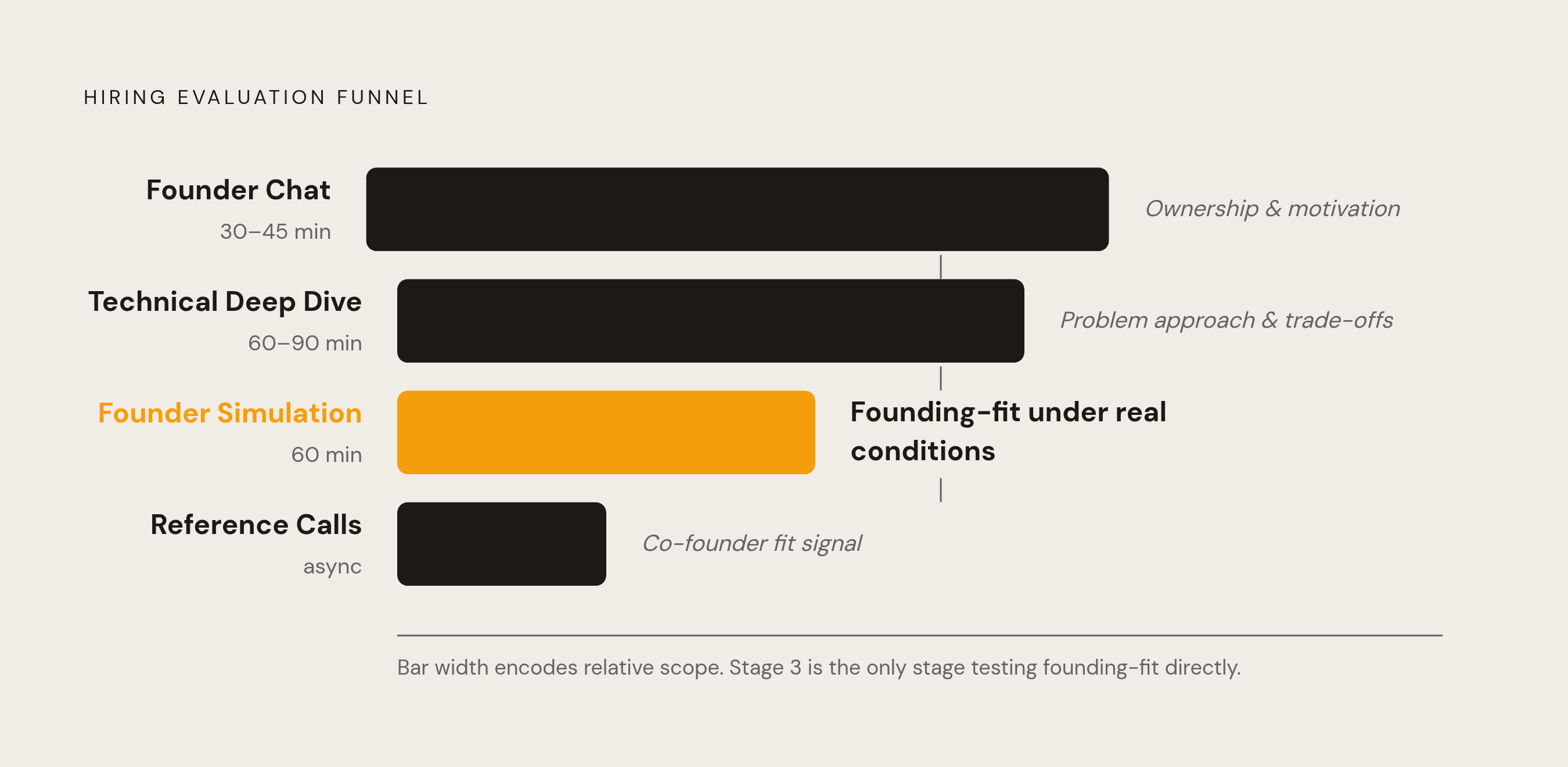
Stage one is the Founder Chat, thirty to forty-five minutes built around questions like "Tell me about a product you built from scratch," "What would you build if you started a company tomorrow," and "What's your relationship with risk and ambiguity?" These surface ownership mentality and motivation. Stage two is the Technical Deep Dive, sixty to ninety minutes of live coding or system design focused on how candidates approach problems and what trade-offs they made in prior projects, not credential verification.
Stage three is the Founder Simulation: sixty minutes presenting a real problem the company is facing, watching how the candidate breaks it down, what questions they ask, and whether they make decisions with incomplete information. Stage four is reference calls, specifically asking former colleagues "Would you want them as a co-founder?" and "How did they handle ambiguity?" These questions elicit founding-fit signal rather than performance-review language. The red flags belong in the scorecard before interviews begin: only talks about technology rather than business impact, needs detailed specs before starting, cannot explain decisions simply, no evidence of side projects or curiosity. Structured scoring tools that hide peer ratings until each interviewer submits independently are the process design fix, per a University of Washington study published November 2025.
How AI handles the process load so the founder's judgment stays on what matters
For a solo founder or lean team without a dedicated recruiter, AI process automation is not a shortcut. It is what makes a disciplined search operationally possible at all. AI owns resume screening, scheduling, note-taking, and pipeline tracking.
That division matters because it prevents AI from overstepping into judgment calls that belong to humans. It delivers only candidates worth meeting, with evidence attached, rather than a pipeline the founder must re-evaluate from scratch. Fragmentation is where calibration gets lost.
The final hiring decision must stay with a human, not as a compliance hedge but because the technical co-founder relationship is a long-term partnership. Its success depends on the founder's judgment about fit, not an algorithm's pattern match on credentials. AI handles the volume so that judgment has room to operate.
Structuring the partnership terms to make the offer competitive and durable
Equity distribution and vesting terms are not negotiation tactics. They are signals the candidate reads to assess how seriously the founder understands the partnership, and getting them wrong loses the finalist to the competing offers they are already fielding. The benchmarks are directional. At pre-seed, the first engineering hire typically receives 1% to 3%. At seed, engineering hires two through five receive 0.5% to 1.5%.
Vesting follows a standard structure: four years with a one-year cliff, and some founders offer acceleration provisions. The equity conversation itself is a signal that separates founders who have done the work from those who haven't. CRV's 2026 playbook frames it plainly: a token stake tells the candidate and investors alike that the founder either undervalues technical capability or doesn't understand the market.
Cash is below market by design, typically fifty to eighty percent of market rate, offset with meaningful equity. That structure requires the founder to be honest about runway and cash constraints from the first conversation. The partnership terms reflect how seriously you took the process from the start. That is what the finalist reads, and it is what decides whether they sign.