Validating Hiring Plans Against Real Talent Market Data
Use labor market data to test hiring plans before they fail.

Most hiring plans collapse for a simple reason: nobody tested whether the plan was possible before anyone started executing it. A 2026 analysis found that 90% of companies missed their hiring goals, with more than a third landing below half their targets, and the root cause in most of those cases traces back to planning, not sourcing effort.
Why most hiring plans fail before sourcing ever begins
A hiring plan usually gets built on a guess about how many qualified people exist for a role. That guess treats a broad professional population, everyone with a relevant title on a professional networking site, say, as if the whole group were reachable and willing, and it isn't. Real supply requires filtering for seniority, specific skills, geography, and compensation fit, and most plans skip that filtering. A hiring plan built on skipped filtering produces not a slower search but a hiring plan that was never achievable, decided weeks before the first message went out. Gartner HR research found that only 31% of recruiting functions use labor market data to shape their talent strategy at all; most teams are building plans on instinct and historical headcount models rather than on what the market can actually deliver right now.
What a realistic addressable talent pool looks like
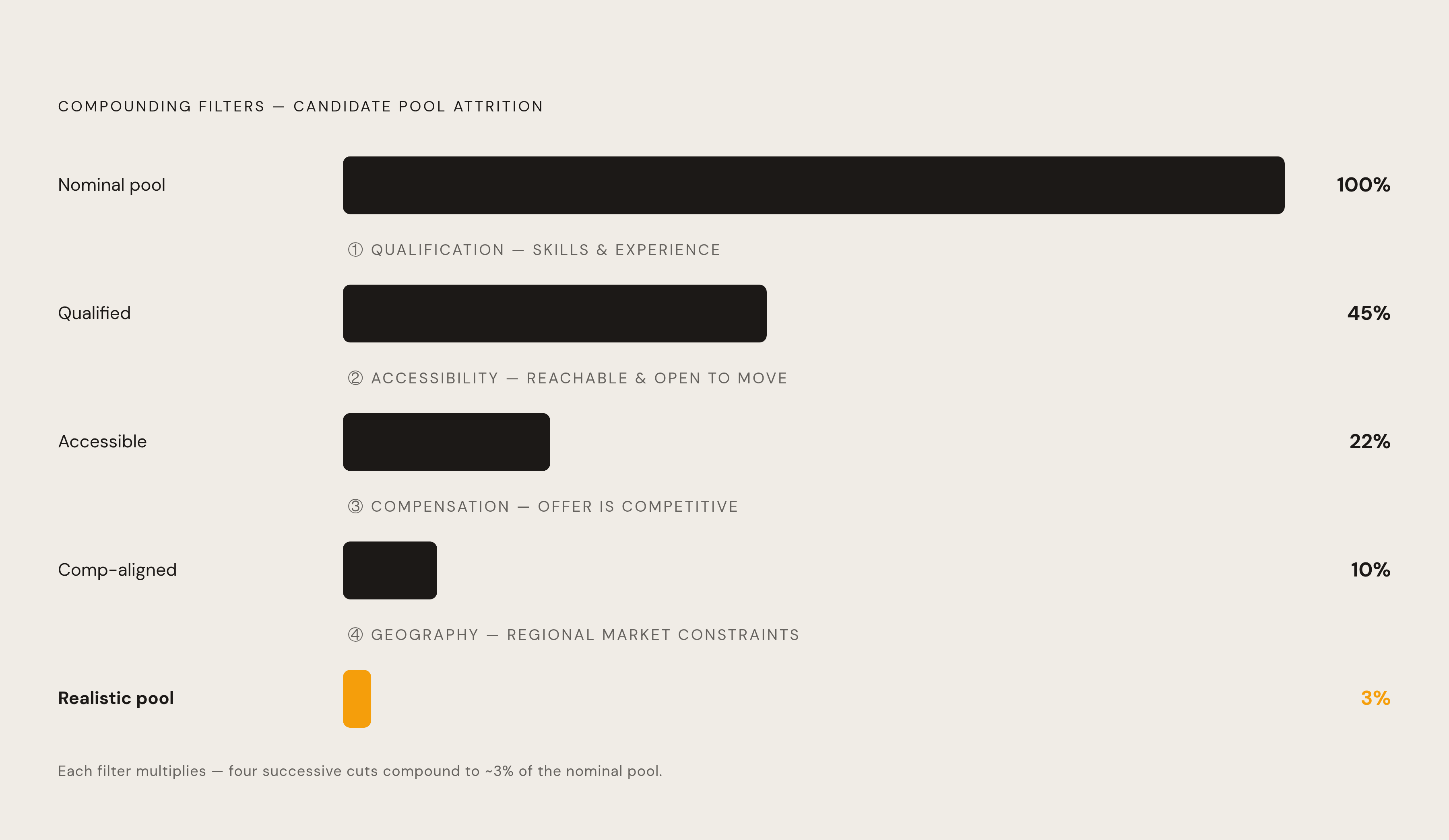
Getting to a real number means running the pool through a sequence of filters that compound. Start with the total potential pool for a role: everyone who might carry the right title or background. Multiplying that by a qualification rate gives the share who actually meet the bar on skills and experience. Multiply that result by an accessibility rate, the share who are reachable and open to a move. Multiply again by compensation fit, the share for whom the offer is actually competitive. Each filter cuts the number, and because they multiply rather than stack, the cuts compound fast. A large nominal candidate pool can turn into just a small fraction of realistic ones once all four filters apply. Geography sharpens this further. A senior engineering role sourced across one region draws from a market shaped by one set of compensation norms, visa rules, and competing employers. The same role sourced in another region draws from an entirely different supply curve, different salary expectations, different availability, different competitive pressure. Treating those as interchangeable markets is how a plan gets built on a number that was never real. Skipping this calculation before posting a role leaves a team optimizing its execution against a target that may not exist in the market.
Market Intelligence as a Continuous Signal
Teams that consistently hit hiring goals score supply against active demand by role and region on an ongoing basis, not once a year during headcount planning. Real-time Talent Availability Indexing, built on live job posting data, shows not just where talent is scarce but by how much, in which specific markets, and whether that gap is widening or narrowing. That distinction matters because supply conditions move. A market that was candidate-rich six months ago can tighten fast if three well-funded competitors enter it and start bidding for the same people. A snapshot taken at the start of a planning cycle won't catch that shift, and a plan built on stale data will keep pointing a team at a market that no longer behaves the way it did when the plan was written. Continuous indexing produces a pre-sourcing reality check: it either confirms the plan or surfaces a conflict early, while there's still time to adjust the role, the geography, the compensation band, or the timeline. Tools that build live market intelligence directly into hiring workflow can run this filtering automatically, applying qualification, accessibility, and compensation fit in real time so a team knows before sourcing begins whether the plan is grounded in reality. The market should be allowed to push back on a plan before a team burns weeks chasing the wrong person, in the wrong place, at the wrong price.
How calibration failures compound the market intelligence gap
Accurate market data solves only half the problem. A plan can be grounded in a correct read of supply and still fail if the criteria used to define a good candidate are wrong. The most common failure is defining a role by credential patterns, title, employer brand, degree, that feel familiar but aren't actual evidence of the capability the role requires. This failure mode gets worse once AI enters the screening process, because a model finds patterns in whatever data it's given. If those patterns overweight call-center titles and underweight hospitality experience for a role that actually requires customer de-escalation skills, the model will miss strong candidates while surfacing weaker ones who happen to match the familiar pattern. False positives aren't a minor sourcing inefficiency. They consume interview capacity, delay the hire, and often end in the wrong person getting the job. Calibration has to work as a living standard rather than a job description written once and left alone. Every interview should feed back into what "exceptional" actually means for that team, and every change to that standard should stay visible and require human sign-off. A job description describes a role. Calibration captures what exceptional performance looks like at this company, for this team, at this stage, and those are not the same thing. Conflating them is how strong, non-obvious candidates get filtered out before anyone ever sees their name. An AI hiring manager that continuously indexes talent availability against active demand, and that pressure-tests a company's actual definition of exceptional against real market supply, can catch this kind of calibration failure before it compounds into a pattern of false positives and false negatives across an entire search.
How AI-generated applications corrupt the sourcing signal
Teams that gauge talent availability by watching inbound application volume are now working from a corrupted signal. AI-generated applications have inflated apparent supply without improving real fit. When every application looks polished and precisely tailored to the job description, credential-matching stops telling a team anything useful, because surface alignment no longer reflects actual qualification. The tools built to catch this aren't reliable either. Recruitment leader Greg Savage has flagged that AI screening tools produce wildly inconsistent results, with minimal shortlist overlap when three different AI tools were run on the same candidate data. That inconsistency means a team can't simply bolt a detector onto the top of the funnel and trust the output. The better response treats detection as a flag for deeper review rather than an automatic filter, and shifts evaluation toward demonstrated work and skills assessments that are harder to fabricate than a resume or cover letter. This makes the case for market intelligence sharper, not weaker. If inbound signal is degraded, a team needs supply-side data that doesn't depend on what a candidate chooses to present on an application.
What the validation workflow looks like before sourcing begins
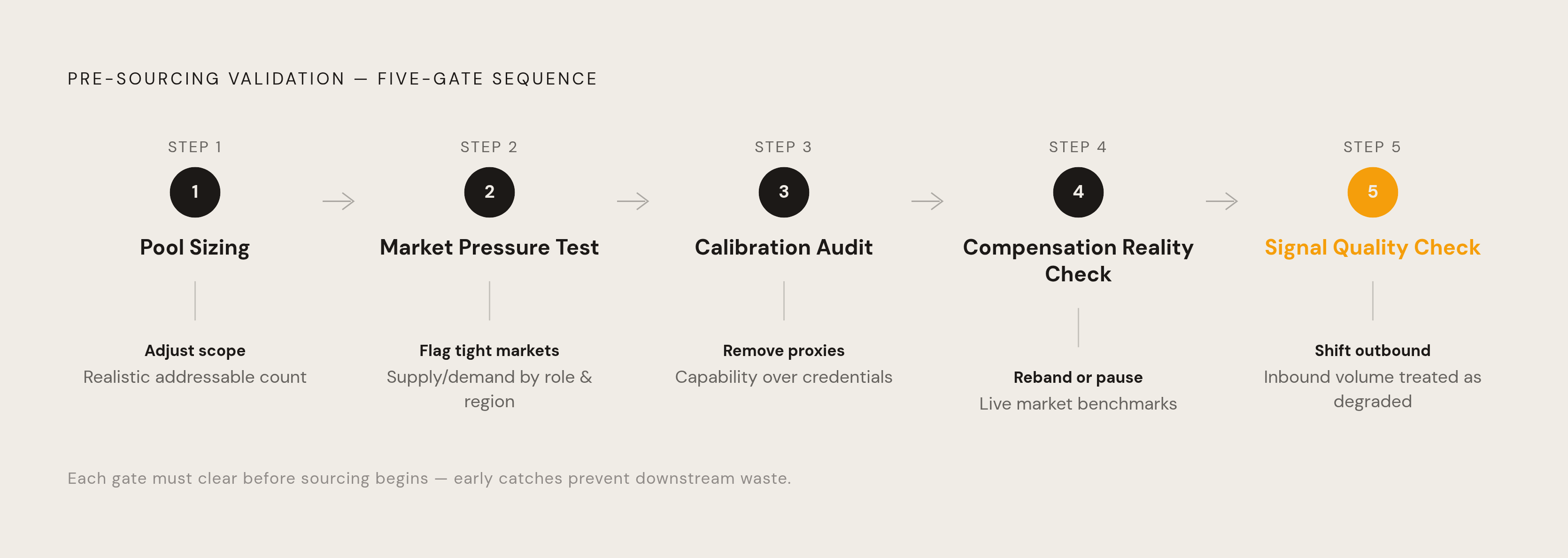
Validating a hiring plan runs as a defined sequence of checks, and each step produces a specific decision. The first step is pool sizing: apply the compounding filters, qualification rate, accessibility rate, compensation fit, to the total potential market and arrive at a realistic addressable number. If that number is too small to meet the hiring timeline, the plan gets adjusted now, before anyone starts sourcing. The second step is a market pressure test: check real-time supply and demand conditions by role and region, and if posting durations in the target market are running long while demand stays high, expand the geography, adjust the compensation, or revise the timeline before sourcing begins. The third step is a calibration audit: before any sourcing tool gets deployed or any outbound message gets written, confirm that the criteria defining "exceptional" rest on demonstrated capability rather than credential proxies, and that those criteria have been checked against recent interview feedback. The fourth step is a compensation reality check: benchmark the advertised pay against live market data for the role and region, since a band that sits below market doesn't just slow the hire down, it removes an entire segment of candidates from the addressable pool before a single message goes out. The fifth step is a signal quality check: treat inbound application volume as a degraded signal in the current environment, and build the sourcing strategy around outbound and data-driven approaches instead of waiting for applications to reveal what the market actually looks like. Running all five steps produces a hiring plan tested against reality, with explicit decisions made about every trade-off, rather than a set of assumptions that quietly surface as missed goals three months later.
Running validation without a dedicated research function
This discipline matters more for early-stage teams than for large ones, because a single miscalibrated hire costs a small team proportionally more of its runway and attention. The tooling required to run this validation is now within reach of a team with no dedicated research function. AI-powered platforms that once required enterprise budgets are now priced for startups, and a growing share of early-stage companies already use at least one AI-powered recruiting tool. AI handles the market intelligence, the pool sizing, and the outbound sourcing, while the founder stays in the loop on calibration, what exceptional actually looks like, how that definition updates after each interview, and whether the plan is being adjusted based on what the market keeps returning. This is the shift that changes the economics for lean teams: an AI hiring manager that learns a company's definition of exceptional, pressure-tests it against live market data, and runs the full sourcing loop builds the validation work directly into the process instead of layering it on top as a separate research function. Lantern is built for exactly this operating model. It learns what a team values through a short onboarding session, surfaces the realistic talent pool for the role, and runs outbound sourcing, AI interviews, and candidate engagement, delivering only people worth meeting, with evidence of fit attached, so a founder's time goes toward judgment and relationship.
The human role: judgment, not validation theater
The biggest risk as AI takes on more of the validation and sourcing workflow is that human review turns into a rubber stamp on AI output. SHRM research found that around three-quarters of HR professionals believe AI will heighten the value of human judgment over the next five years rather than diminish it, and the logic holds up: as AI absorbs transactional work, the moments where a human steps in start to carry more weight, not less. That shift only pays off if the human layer stays real. A Greenhouse 2025 survey found a large majority of hiring managers trust AI decisions while only a small fraction of job seekers believe AI makes hiring more fair, and a separate Gartner survey found a similarly small share of candidates trust AI to evaluate them fairly. That gap between how much hiring managers trust the system and how little candidates do only gets wider when the human review layer looks thin from the outside. Human-in-the-loop hiring works as a design principle, not a fallback bolted on for optics: AI surfaces information and recommendations, and humans stay responsible for interrogating those outputs and making the final call. Treating that as a deliberate design choice, rather than a checkbox at the end of a workflow, is what separates serious AI adoption from a shallow version of it. Genuine human judgment in this workflow looks specific: reviewing false positives and false negatives from AI screening on a regular cadence, updating calibration criteria based on what interview feedback actually reveals, and keeping the reasoning behind every change to a hiring standard visible. The final hiring decision has to stay with a human because the consequences of a hire belong to the team making it, and accountability without the authority to decide doesn't hold together. The teams that hit their hiring goals test the plan against reality before sourcing starts, define exceptional by demonstrated capability rather than credential proxy, let AI run the process, and keep human judgment exactly where it belongs: in calibration, in final decisions, and in the relationship with the candidate.