When AI Candidate Ranking Degrades at Small Data Volumes
Small data makes AI rankers unreliable, pushing them toward credential patterns instead of fit.

How conventional AI rankers are built to assume volume
AI ranking tools get better the more data they eat: clicks, dwell time, who got interviewed, who got an offer. That's the raw material, and it accumulates in useful quantities only after a system has run a long time, across a lot of candidates. Early-stage hiring teams open a role, get a dozen resumes in, and expect the ranking to already know what "good" looks like. Early-stage hiring teams open a role, get a dozen resumes in, and expect the ranking to already know what "good" looks like, but the data can't support that expectation yet. That gap between what teams expect and what the data can support is where most of the frustration with these tools actually starts.
Research published on arxiv (2609.18188) shows that training a standard deep neural ranker from scratch is infeasible in a lot of recruiting contexts. Low-traffic or niche sourcing situations don't produce the millions of interactions these models need to find real patterns. Ten candidates is a coin flip with extra steps. It's a coin flip with extra steps.
Recommendation systems have wrestled with this exact problem for years. New users or items entering a system with no history cause prediction quality to fall apart. Research on recommendation systems shows that when a new item or a new user enters a system with no history attached, prediction quality falls apart. Swapping "item" for "role" makes the parallel hold exactly. A company hiring for a discipline it's never touched before, or a team lead running a search for the first time, is the new item. Zero prior data means zero calibration, no matter how good the underlying model is.
Hiring has a wrinkle recommendation engines mostly get to skip. A blender is a blender whether it sold ten units or ten thousand. "Good," in hiring, keeps moving. It shifts across roles, and it shifts inside a single search as the team looks at real candidates and revises its own sense of what's actually out there.
Switching vendors won't fix this. The dependency is baked into the architecture. Any ranker trained this way inherits the same appetite for volume it hasn't been fed yet.
What zero-shot LLM scoring does when asked to rank candidates without task-specific alignment
The workaround most tools reach for when there isn't enough volume to train a ranker is zero-shot LLM scoring. Feeding the model a job description and a resume and asking it to rate fit is simple to build, easy to demo. Simple to build, easy to demo. It's also where most of these tools quietly go wrong, and the wrongness is structural, built into how the approach works.
Zero-shot means the model was never aligned to this task, this team, or this bar for "exceptional." The same arxiv research shows zero-shot LLM scores are unstable and non-deterministic. The same arxiv research shows zero-shot scores can shift across runs and that model explanations can be inconsistent for the same profile.
What does that mean for a recruiter using the tool on a Tuesday morning? The ranking isn't reproducible. Run a search Monday, get one top five. Have a colleague run the identical search Tuesday, get a different one. Nothing about the candidates changed. Only the model's roll of the dice did.
What causes that noise? Without task-specific alignment, the model has no grounded idea of what "exceptional" means for this specific team. So it reaches for the next best thing: statistical patterns baked in from training data. Credential names. Employer brand. Title conventions. Those become the substitute for real fit signal, and they're precisely the wrong proxy for a team trying to hire on demonstrated ability rather than pedigree.
That said, none of this is inevitable. The same arxiv paper describes single-token expected-value scoring, a method that lets small language models rank candidates accurately even under severe data scarcity, outperforming both heuristics and zero-shot LLMs in evaluations described in the paper. That's a deliberate architecture choice, not something a team gets by default from a generic LLM call. Most ranking tools on the market today simply aren't built that way, and that gap is worth asking a vendor about directly.
How sparse interaction signals leave the model with nothing to weight
Interaction signals are the behavioral breadcrumbs that tell a system what a specific team actually values: how long a hiring manager lingered on a profile, which candidates got clicked into, who made it to onsite, who got an offer and accepted it. Over time, those breadcrumbs add up to something close to taste.
At small pipeline volumes, that picture doesn't exist. Or it exists in quantities too small to pull anything statistically meaningful out of.
Herohunt.ai notes, from the practitioner side, that AI works best with a large volume of data, and for very small hiring needs or unique one-off executive roles, predictions can be less reliable simply because the data is too sparse. That's a description of the math, not a knock on any particular vendor. Research on recommendation systems published in an academic journal backs it up from the modeling side: when user-item interaction data is sparse, prediction accuracy suffers. "Sparse" doesn't mean zero here. It can mean dozens of interactions, which sounds like plenty until it's measured against the millions these models were built to run on.
So what fills the gap when there isn't enough signal to weight anything? Surface features step in: keyword overlap between resume and job description, credential patterns, title seniority. Those become the fallback, and they're exactly the wrong proxies for a team trying to hire on what someone actually built rather than where they built it. A hiring team that trusts a ranking without knowing this is, in effect, outsourcing its taste to historical averages it never agreed to.
Why early-stage teams hit all three failure conditions simultaneously
Early-stage teams tend to hit all three failure modes, sparse signal, non-deterministic scoring, and shifting criteria, at the exact same moment. It's what "early stage" mechanically means. It's what "early stage" mechanically means.
A new role type means no historical interaction data and no calibrated benchmark. Cold start, full stop, on every dimension at once. Hiring at this stage is usually founder-led, or run by one generalist wearing five hats. The calibration an experienced recruiter would normally bring, the instinct that catches a bad ranking before it wastes anyone's afternoon, simply isn't in the loop.
Practitioners have observed what happens next: tools that generate scores or recommendations without clear reasoning can feel good enough in the early days, but as hiring volume climbs, the blind spots turn into inconsistent shortlists and confused hiring managers. What felt like a shortcut becomes a source of friction nobody planned for.
Speed makes this worse, not better. Early-stage teams tend to value speed over sophistication. Founders take the ranking output at face value instead of asking whether the conditions for a reliable ranking even exist. Nobody here is being careless, to be fair. Interrogating a tool that's supposed to be saving time takes more time than most teams have to spare.
For niche or executive-level roles, research from recruiterflow.com points to the right architectural answer: AI should augment the process, not replace it, when volume is low and complexity is high. That's the correct posture on paper. Adopting it under deadline pressure, with a role to fill by Friday, is an entirely separate problem.
Put together, the pattern is almost backwards from what you'd expect: the teams with the least slack, the ones leaning on AI hardest to make up for a thin bench, are also the teams operating furthest outside the conditions where ranking output means anything.
How uncalibrated rankings produce false positives and screen out the candidates worth meeting
Two things go wrong here, and they pull in opposite directions.
Polished-but-weak candidates score high because their resume matches surface patterns the model learned somewhere else entirely: right school tier, right employer tier, right title progression. They advance, they get interviewed, and they burn hours of a hiring manager's week that could have gone somewhere better. Strong-but-non-obvious candidates, career switchers, self-taught engineers, people who did great work at a company nobody's heard of, score low because their profile doesn't fit the credential mold. They never surface. That second failure is the expensive one. A team never even learns what it missed.
Herohunt.ai notes that many recruiters report AI is already helping them find candidates they wouldn't have found any other way. But that effect appears only when the AI is working from criteria calibrated to the team, not defaulting to pattern-matching on credentials. When that calibration is stripped out, the same mechanism that could reveal hidden talent when tuned to the team's own criteria instead reinforces the exact conventions that made that talent hidden.
A supportfinity.com blog post cites a figure claiming a large share of organizations using AI-powered recruiting tools report only minimal improvement in candidate quality despite heavy spending, attributed to a Deloitte report whose title and existence could not be verified. Treat that number with real suspicion. Directionally, though, it tracks with what the mechanics above predict: tools running outside their valid operating range produce underwhelming results, regardless of spend.
The cost asymmetry bites hardest at small scale. Industry estimates suggest a bad hire can run up to a significant share of that person's first-year earnings. At an early-stage company, one false positive that makes it all the way to an offer is a disproportionate hit, in dollars and in the months lost re-running the search from scratch.
The conditions that must exist before AI ranking output carries real signal
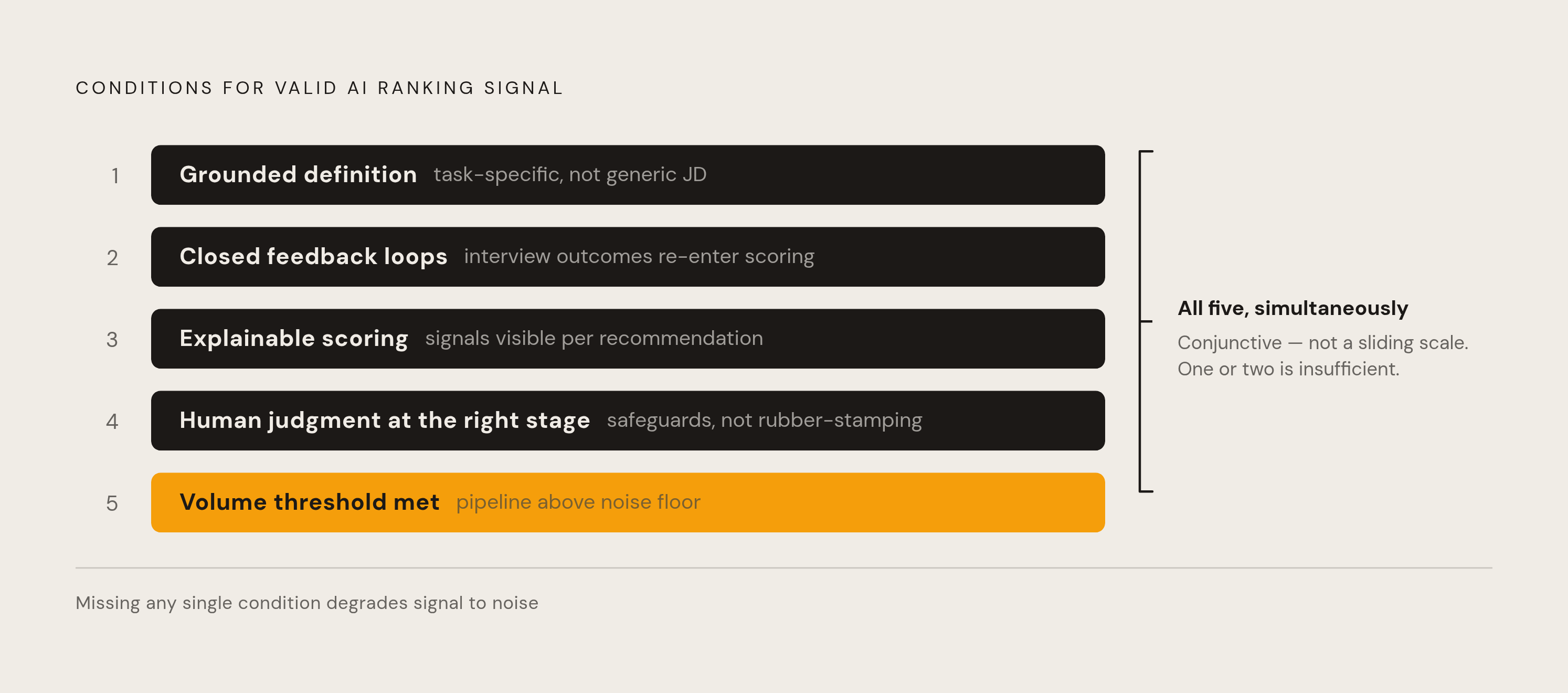
When does a ranking actually mean something? Five conditions, and they need to show up together, not one or two at a time.
A grounded definition of exceptional comes first. Not a generic job description, but a standard calibrated to this team and this role specifically. The arxiv research shows task-specific alignment is what separates accurate ranking from zero-shot variance.
Feedback loops that actually close come second. Interview outcomes need to feed back into the scoring, or the model never learns what "exceptional" produced at this specific company. Without that loop, every ranking is a guess wearing a score's clothing.
Third: explainable scoring. Greenhouse.com frames explainable AI in recruiting as a tool that shows which signals drove a given recommendation. Without that visibility, a hiring team has no way to catch the credential pattern-matching or the false negatives described above. The score just arrives, unexplained, and gets trusted or ignored on faith alone.
Fourth: human judgment at the right stage, and this one deserves more scrutiny than it usually gets. Herohunt.ai notes that most organizations keep AI in a support role rather than letting it touch the actual hiring decision. AI surfaces and ranks, a human decides, which sounds like a clean safeguard on the surface. But Research found human review is a weaker safeguard than assumed, catching AI's mistakes reliably only when extra safeguards are built into the review step itself. A human rubber-stamping a ranking is not the same thing as a human actually checking it, and mistaking one for the other is where this safeguard quietly fails.
Fifth: awareness of the volume threshold itself. A team should know, before it starts relying on a ranking, whether there's enough pipeline for the model to be operating above noise. When there isn't, treat the output as an exploratory sort. Something to skim for ideas, not an authoritative order to work down top to bottom.
None of these five bolt onto an existing tool stack after the fact. They need taste, market awareness, and execution built into one system, rather than scattered across five platforms that never talk to each other.
What a unified AI hiring system does differently when pipeline volume is low
Most companies run a fragmented stack: an ATS that doesn't talk to the sourcing platform, an assessment tool sitting in its own silo, compensation data that's a quarter out of date. Supportfinity.com notes that fragmentation means the "AI" piece is often making ranking calls on incomplete data before data volume even becomes the limiting factor. In other words, the system was broken before data volume even became the limiting factor.
What changes when the system runs as one connected loop instead of a patchwork? A few things, mechanically, and none of them are cosmetic touch-ups.
Calibration during intake, before sourcing even starts, gives the ranking layer a grounded definition of exceptional from day one. That cuts the dependency on logged interaction history that, for a new role, simply doesn't exist yet.
Real-time market benchmarking acts as a sanity check against wishful thinking. When a system compares a team's stated hiring criteria against what's actually available in the market before ranking begins, it catches unrealistic bars early: criteria describing a candidate who doesn't exist at the salary or location on offer. That produces a ranking accurate to the real pool instead of an imagined one.
Evidence-of-work scoring, weighing what a candidate has actually built over where they built it, directly corrects the false-positive mechanism zero-shot LLMs inherit from their training data. It's a deliberate counterweight to credential pattern-matching, not a happy accident of design.
Agentic systems that run the whole loop, outbound sourcing, AI interviews, assessments, scheduling, generate their own interaction data as they go. That starts closing the feedback loop from candidate one, instead of waiting months for historical data to pile up on its own. Deloitte's Global Human Capital Trends report, cited by recruiterflow.com, describes agentic AI now managing entire candidate pipelines end to end, with agents built to know when to act on their own and when to hand off to a human. That handoff point is exactly where early-stage teams recover the judgment layer that uncalibrated ranking otherwise skips past.
What's left for the human in this picture? Not the administrative churn: not routing resumes, not scheduling calls, not running scores by hand. Judgment. Reviewing evidence-backed finalist packets. Approving changes to the hiring standard as the team learns more about its own market. Making the final call. Every change to that standard stays visible, something a person actually signed off on, instead of getting quietly absorbed into a model update nobody can see or question.
How hiring teams should read AI ranking output given what they now know
Trust the ranking when explicit criteria got set before sourcing began, the scoring shows its work, revealing which signals drove which rank, and feedback from earlier interviews has already started shaping the model. That's a ranking built on something real, not on vibes borrowed from a training set.
Hold it loosely when the role is new to the team, when the pipeline sits below the volume where statistical signal starts to mean anything, or when the score arrives with no explanation attached. Treat it as a first pass under those conditions, a starting point for a conversation rather than a verdict.
A few concrete red flags appear in the ranking itself, if you know to look. Top candidates clustering around the same credential markers, same school tier, same employer tier, when the actual role criteria never asked for that, is pattern-matching wearing a fit score's clothes. Rankings shifting meaningfully between two runs with no new candidates added is the non-determinism signature described earlier, visible in real time on your screen. Candidates with non-traditional paths consistently missing from the top of the list is the false-negative pattern, and it's reason enough to pull a few of those profiles back out for a second look before writing them off.
The payoff for doing this calibration work upfront compounds over time. Recruiterflow.com's research notes that for high-volume roles, AI can automate up to 90% of the process, but that number only holds once the underlying calibration has been done first. Early-stage teams that build grounded criteria now are laying groundwork for a feedback loop that gets sharper as their pipeline grows, rather than one that needs rebuilding from scratch six months in.
AI ranking degrades at small data volumes in ways that are predictable, and once the pattern is visible, fairly easy to catch. The fix isn't blind faith and it isn't blanket rejection either: it's calibrated trust. Know what conditions the ranking needs to mean anything, and keep a human hand on the wheel for the calls no amount of interaction data will ever replace.