One Platform That Sources Screens Interviews and Schedules Without a Human Recruiter
Unified platforms eliminate hiring handoffs by using one calibrated standard across every stage.
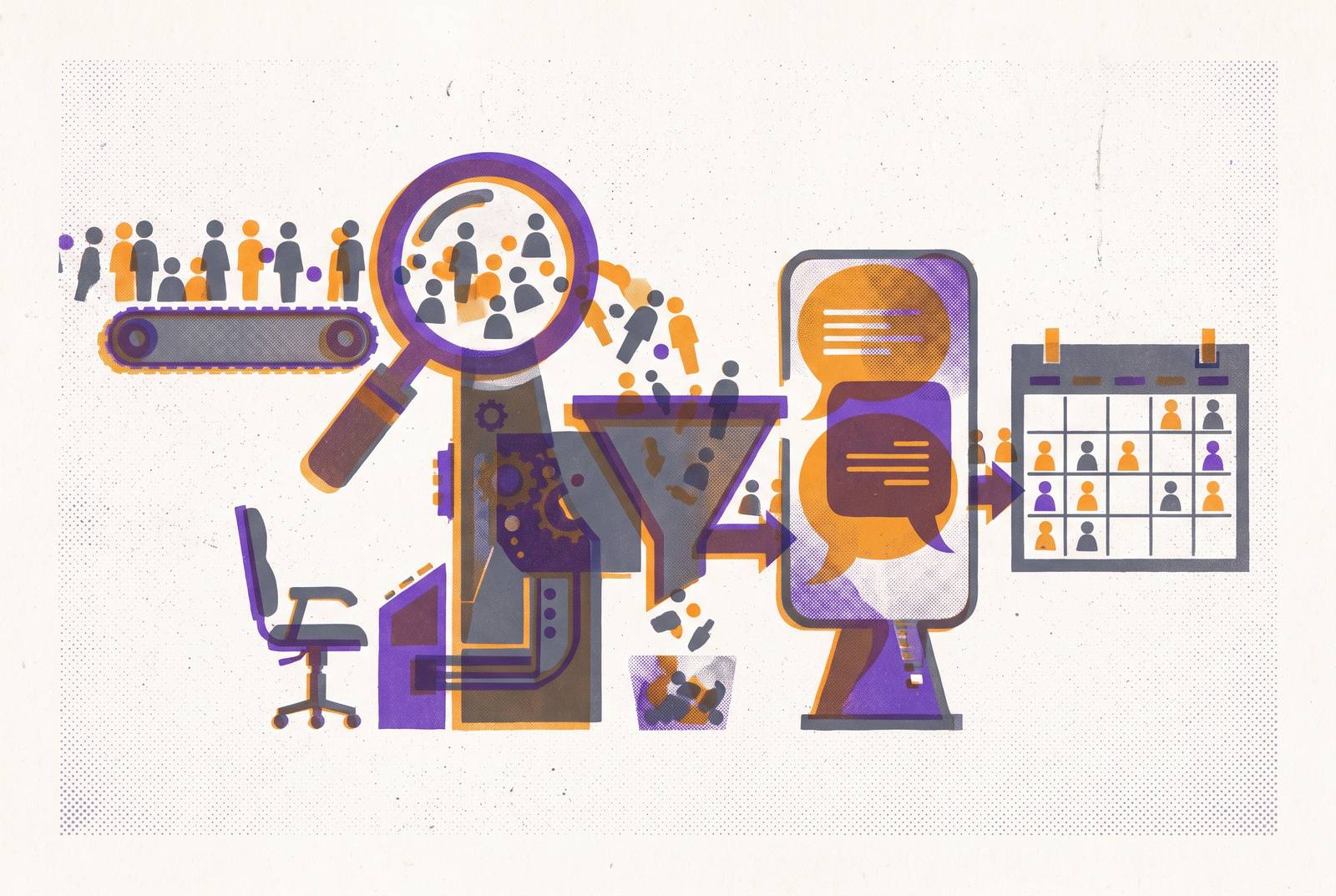
A single AI hiring platform can source, screen, interview, and schedule without a human recruiter, but only when every stage uses one coherent, calibrated standard of fit. For an early-stage startup without an HR team, that means automating coordination while keeping founders responsible for judgment and the final hire. The real gain comes from eliminating the handoffs where the company’s definition of “exceptional” gets lost.
Why stitching together point tools doesn't produce a recruiting process — it produces a series of handoffs
A recruiter buys a sourcing tool, then finds that they need outreach software to contact candidates. They need a scheduler to book the interested candidates and an assessment layer to assess them. Each purchase solves a real, local problem. Yet the recruiter still has to move people between systems and explain, at each transition, what the previous tool was meant to find.
A sourcing tool ranks candidates with its default signal weights, while a separate screening tool uses its own view of fit. The scheduling bot knows when an interviewer is free, but not why a candidate deserves that conversation. Because different people may have configured those systems independently, each stage can quietly redefine what “exceptional” means. An automated step is not a shared hiring process.
A team may have automated searches, messages, and bookings but still need a person to sort out standards that conflict. What happens when sourcing rewards employer brand but the hiring manager wants to see the specific work a candidate has done? The mismatch reaches the shortlist before anyone resolves it, leaving the recruiter to repair a decision the stack was never equipped to make coherently.
What full-cycle automation actually requires before the first candidate is contacted
A unified system needs a shared, inspectable definition of what the role demands before it can make useful decisions. A job description rarely supplies that definition. It names responsibilities and credentials, but usually leaves out the evidence that would distinguish a strong hire for this particular team. Without that evidence, the system has to infer intent from titles, employer names, and credential patterns.
Calibration spells out those hidden preferences in an ideal candidate profile. This is a concrete definition of success that becomes the reference point for sourcing criteria, screening rubrics, interview questions, and scheduling priority. Advancing a candidate requires evidence that justifies the decision. That shift addresses the misalignment between what recruiters source and what hiring managers will accept.
The proposed 15-minute calibration does not have to turn into a big job of rewriting job descriptions. Its purpose is to establish one source of truth. The profile must also be able to improve as interviews reveal which signals help distinguish strong candidates. However, feedback should not silently rewrite the rules through a black-box model. People should be able to see and approve each change so that the system learns from the process while staying true to what the hiring manager wants.
How agentic AI handles sourcing, outreach, screening, scheduling, and assessment when they share one standard
With a calibrated profile in place, sourcing can search for evidence of capability. Semantic and skill-inference matching can surface candidates whose work fits the role even when their titles do not. Search breadth also changes who becomes reachable. Platforms that look across GitHub, patents, publications, and Stack Overflow, rather than only LinkedIn, are better positioned to find specialists outside high-noise channels. The shared profile gives that broader search a clear target.
Personalized sequences across email, LinkedIn, and SMS can refer to the candidate’s actual profile and its connection to the role. There is no separate tool reinterpreting the match. When a candidate responds, structured first-round interviews can assess them through voice, video, or conversation against the calibrated rubric. Scored transcripts let the hiring manager see the evidence behind the result.
Once a candidate clears the screening threshold, scheduling becomes a continuation of that decision. The platform books the human interview against real-time availability, handles panels and time zones, and manages rescheduling without a coordinator. Speed is only part of the benefit. Candidates who meet the threshold get the same next step without waiting for a person to move them to it. Technical or role-specific assessments can then attach to the same candidate record and use the same standard, leaving the hiring manager with one evidence package.
What the talent market actually looks like before a hiring plan goes live
Even a precise definition of fit can describe someone the team cannot hire at its expected compensation and timeline. Calibration establishes what the company wants. Market intelligence must test the plan before sourcing begins. A unified platform should expose the tension between required skills, available supply, compensation, and timing rather than merely produce candidates who appear to validate the brief.
For technical roles, that tension also leaves less time to make a decision. Candidates may be in several hiring processes at once while AI startups see the race for talent as zero-sum. An internal compensation band does not settle those external pressures. If the platform surfaces expectations only after screening, the team can spend a full cycle reaching finalists whose other offers it was unprepared to match. Early market data shows that conflict while the team can still change the plan.
Where qualified candidates are scarce, inbound recruiting may produce no shortlist, making outbound recruiting necessary. But more outreach cannot resolve every mismatch. The useful output is a revised hiring plan, with adjusted criteria, compensation, or timing, or a decision to deprioritize the role until supply conditions change. Market intelligence earns its place by pushing back on assumptions.
Why credential-matching surfaces the wrong candidates and how a calibrated system finds the right ones
Even a hiring plan that fits the market fails if screening looks for the wrong evidence. Keyword-based screening rewards how well a résumé mirrors the job description, which is not the same as how well its author can do the work. A polished résumé from a weak candidate can outscore a plain one from a strong candidate. That creates errors in both directions. The shortlist gains false positives while the reject pile collects false negatives.
The cost falls especially heavily on non-obvious candidates. Filters built around familiar patterns can hide strong performers who have no brand-name employers, career-changers, and specialists whose titles are unfamiliar. Eightfold illustrates the alternative skills-and-potential model, but the principle is broader than any vendor. A calibrated system looks for specific work, demonstrated problem-solving, and domain depth because those are the signals the hiring manager has chosen. Credentials no longer stand in for the evidence the role requires.
Doesn’t an ATS with Boolean filters and keyword customization already do this? Those controls can refine a word-based search. They cannot, by themselves, identify relevant experience when candidates describe it without the language the filter expects. Calibration changes the target of matching, while semantic and skill-inference methods help find relevant evidence expressed in different ways. A wider search and better language matching still fall short if the system ranks people against a standard that has not been clearly defined.
Where human judgment belongs in a process that automation owns end to end
Running the recruiting loop without a human recruiter is not the same as hiring without human judgment. Automation can own sourcing searches, outreach sequences, first-round screening, and scheduling coordination because those tasks are high-volume and repeatable. Founders still own the consequential choices. They evaluate finalists’ motivations, build relationships, decide whether an unexpected candidate deserves a conversation, and make the final hire or no-hire call. For a two-person operation, the opportunity is to remove coordinator work without surrendering those decisions.
The University of Washington’s research published in late 2025 found that people’s decisions can remain vulnerable to AI bias under certain circumstances even when they consider its recommendations low quality or unimportant. Doubting a recommendation does not guarantee independence from it. A platform therefore needs to let users see why it gave a score and act when they disagree, rather than just let them reject a score whose basis they cannot see.
The design requirement follows directly from that finding. Before approval, the hiring manager should be able to see scored transcripts, sourcing rationale, and the screening rubric in the same candidate record. This gives a non-obvious candidate’s evidence a chance to challenge the ranking. Changes to the hiring standard should also require explicit human approval and leave a visible audit trail. Human authority belongs both in individual decisions and in control over the rules that shape future ones.
Compliance, auditability, and data governance as procurement requirements, not afterthoughts
As of 2026, employers using AI in hiring face overlapping obligations whose scope depends on where and how the tools are used. Under NYC Local Law 144, covered automated employment decision tools must have an independent bias audit within one year of use, a requirement that does not mandate individual explanations. Under EU AI Act Annex III, recruitment and selection systems are high-risk, including when companies outside the EU with EU exposure use them in ways the Act covers.
Putting several tools behind one login is not enough to meet those obligations. In a fragmented stack, sourcing logs, screening scores, and scheduling records remain in separate systems with different audit formats. Reconstructing the process afterward can be laborious and incomplete. A unified candidate record and calibrated rubric make it easier to keep an unbroken trail of steps, scores, and approved changes, though bringing them together does not by itself establish legal compliance. Candidate and hiring data also need an explicit boundary, with the platform able to state and contractually verify that data used for a search will not be recycled into shared model training for other companies’ hiring.
How can a small company tell whether a platform replaces its recruiting stack or just bundles the tools?
For a buyer, the practical test is whether every stage reads from and writes back to one candidate record and one standard of fit. A candidate should be able to move from sourced to scheduled without someone leaving the platform or manually transferring data. A shared login proves very little on its own. The vendor needs to show continuity in the decisions.
Buyers should first establish where the calibration standard lives and which stages actually use it. If sourcing and screening apply different criteria, the process is not unified, even if both run automatically. The next question concerns the evidence behind a decision. Can the hiring manager inspect the reasoning for a ranking or rejection in the same interface used to review candidates? If transcripts, scores, and sourcing rationale still require reconciliation across dashboards, the burden has remained with the buyer.
When interview feedback points to a new signal of a strong candidate, the buyer should ask whether every stage gets the update and whether a human must explicitly approve it. Data governance deserves the same direct scrutiny. Where does candidate data go, and can it be used to train shared models serving other customers? These questions distinguish control over a recruiting process from access to a collection of automated functions.
For an early-stage startup without an HR team, the strongest evaluation is therefore not a count of features. It is whether the platform preserves the company’s definition of fit from the first search through the final evidence package. Whether automation operates from one coherent standard or a patchwork of defaults separates a hiring engine from a faster version of the same broken process.